





Results day · 16 November
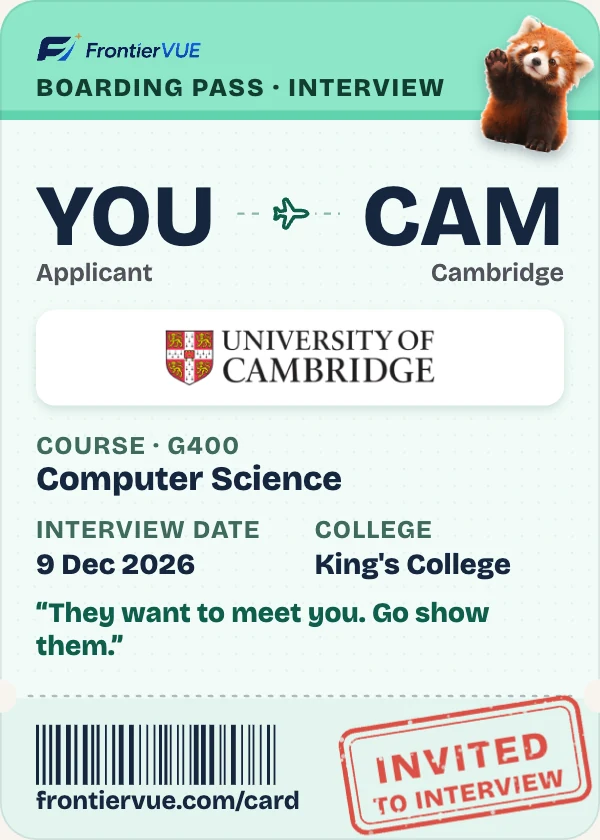
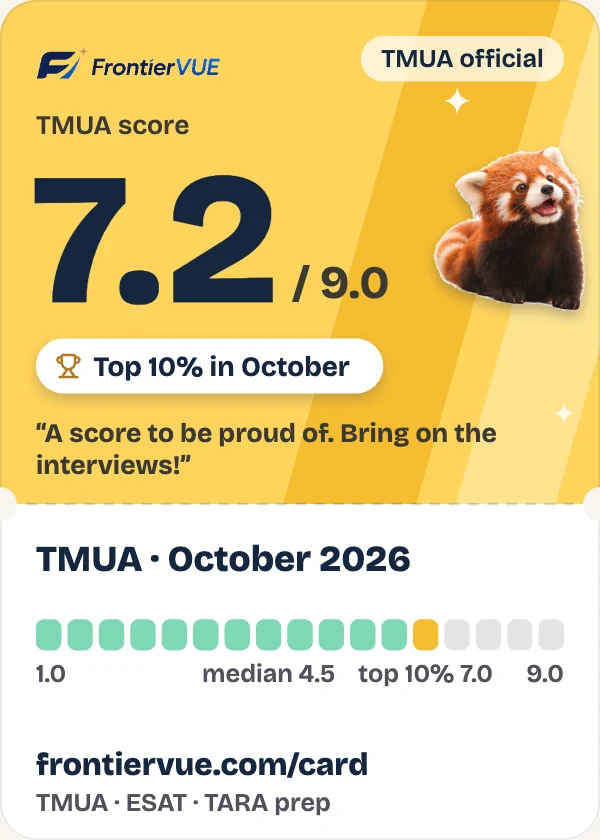
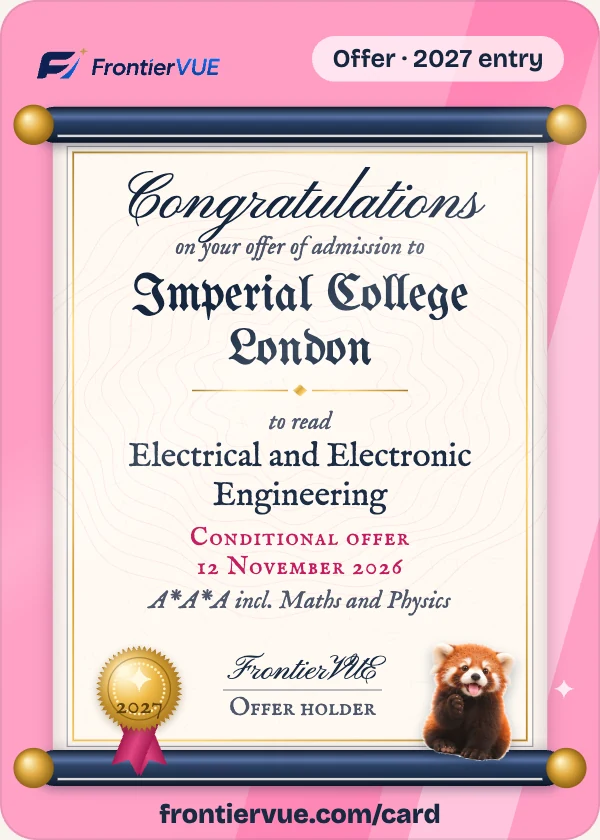
Good news? Make it a card
Offers, interview invitations and TMUA, ESAT or TARA scores, as an animated card in 3:4 and 9:16.
Hands on, no sign-up
Every step, live on this page
Real questions, custom sets, mocks, scores and interviews: it is all below.
Try anything without an account. To keep your progress, sign up free
01
Try a real question
Get it wrong, see why at once
Six questions across TMUA, ESAT and TARA, in our real answering component. Switch subject at the top, move between questions below, and try a wrong option.
- Marked instantly
- A worked solution for every question
- Diagnosis for the option you chose
0 / 6 done · 0 correct
02
Builder
Build exactly the set you need
The real builder from the platform. Pick modules, topics and difficulty, choose unseen or only-wrong questions, and see how many match on the right.
- By topic and difficulty
- Unseen only, or only your mistakes
- Your timing, your length
Practice · Build a session
TMUApractice
588 questions in the bank · a sample account
Sub-types, difficulty, timing and when solutions appear.
What to practise
How many questions you have not seen yet in each module. None selected means every module.
Topics
Pick any number; none = allHow to practise
Difficulty
Session type
Solutions
03Papers and mocks
Every paper, in one place
The live catalogue from the mocks page. Switch between Frontier mocks and official papers. Free papers open straight away.
- Training, timed, or test-day rehearsal
- TMUA papers back to back
- New original mocks regularly
Full mocks · TMUA
04
Score converter
Raw marks to a TMUA score
Our converter uses the official tables and the current scoring. Move the sliders and see roughly where you land.
- Official tables 2017 to 2023
- Current scoring estimate
- No login
Paper 1
Applications of Mathematical Knowledge
12/ 20 correct
Paper 2
Mathematical Reasoning
10/ 20 correct
Model estimate for the 2025/26 cycle, built from official UAT-UK figures. The full tool also has the 2017 to 2023 official tables.
Estimated TMUA score
5.6/ 9.0
Likely 5.0 to 6.1 · 22 / 40 correct
Where you sit
- October sitting≈ 71st percentile
- All candidates≈ 78th percentile
- UK residents≈ 85th percentile
- Outside UK and EU≈ 71st percentile
05
Interviews
After the test, rehearse the interview here
Frontier ACE mock interviews: read the question, think for a few seconds, answer aloud, and get scored on five dimensions.
- Oxbridge interview questions
- Timed, spoken answers
- Five-dimension score
Practise this question on Frontier ACE
A timed preview: read the question, think for a few seconds, then answer aloud. Frontier ACE scores the attempt on five dimensions.
Open the sample questionResults, interviews, offers
Afterthetest,stillwithyou
We’ve got you.From the last question to the offer, something useful at every stop.
- 01
October
Test done
Take a day off before checking answers.
16 November
ResultsNow
·· days to go. How to read your score.
- 03
From mid-November
Interview invites
Students log invites here as they arrive.
- 04
December
Interviews
Rehearse with Frontier ACE first.
January
Offer
Got one? Log it and give next year some hope.


























Skill lessons
One lesson, one skill
01
Method
02
Worked example
03
Common traps
Tap a wrong answer and jump straight to its lesson.
Next could be you
Wanna be part of it?Hop on now!
Free tools · no login
Team
Elite Academic Team


Blair
Imperial College Biomedical Engineering
Founder
Imperial Biomedical Engineering alumna who founded Frontier Academy in 2022. Since then: 160+ Imperial offers, 350+ G5 offers and 200+ personal statements shaped.

Tim
Imperial College Computing (AI & ML)AI Startup CTO@Frontier
Co-founder & Academic Partner
Co-founded Frontier Academy and leads the AI learning engine and platform. Guides Oxbridge and Imperial applicants in Computing, Maths, Data Science and Quant Finance through research and interviews, and tutors TMUA, STEP, Kaggle and USACO.

Jason
Imperial College EEE
Academic Mentor
Teaches ESAT and writes his own lesson plans, handouts and original problems. 90% of his students score 8 or above.

Yichen
Imperial College PhysicsMSc Nuclear Physics, University of Tokyo
Academic Mentor
Coaches Oxbridge and Imperial engineering and physics interviews, and tutors ESAT, BPhO and Physics Bowl.
Exams
Supported Exams
Original question banks for the UK admissions tests that matter. Pick one to start practising.
ESAT
Engineering & Science Admissions Test
Cambridge engineering and natural sciences admissions
2,300+questions
TMUA
Test of Mathematics for University Admission
Mathematics aptitude test for university entry
1,000+questions
TARA
Test of Academic Reasoning for Admissions
Reasoning test for selected Oxford and UCL courses
1,100+questions
STEP
Sixth Term Examination Paper
Cambridge advanced mathematics examination
1,500+questions
Coming Soon
Expanding soon...
Want us to support another exam? Let us know
Question Bank
Scroll the album to browse past papers & mocks. At least 2 free papers in every subject: open and try real questions.
Paper 1
2026 · Jun · 45 Qs · Free to try
Admissions Standards
Aligned with G5 & Russell Group admissions requirements
Each logo opens the university’s own site.
Beyond the test
More than the test
Results, interviews, course requirements and offer updates, all one click from the home page.
Interviews
Timelines, formats and what tutors score for Oxford, Cambridge and Imperial, plus original practice questions by subject.
Results & Scores
Results days, score conversion and per-college score distributions for all four tests.
Tools & Score Analysis
11 free tools: score converters, STEP grades, ESAT module picking, mental maths drills, exam countdowns, college score explorers and LSE acceptance rates by course.
Articles
Policy changes, data notes and post-exam updates, each with its sources and the date we checked them.
Offer Tracker
Live offer and interview updates grouped by university and course.
Perks
Startfree.Itonlygetsbetter.
Free to start
2+ papers + 10/day
At least two full papers per subject, ten more questions every day, and full mistake analysis.
Invite a friend
£6.8
When a friend signs up through your link and first pays, you get £6.8. No cap.
Bursary
Free access
Struggling to pay? Apply and, if approved, get one subject free. Reply within 24 hours.
Pricing
Start free. Pay once, and keep it until results day and beyond.
No subscription, no exam-season expiry, nothing that renews on its own. TMUA, ESAT, TARA and STEP unlock one subject at a time.
Free account
£0/ forever
- 10 questions a day per account, across all subjects, each with a full solution
- At least 2 free papers per subject, plus a 5-question taster before you sign up
- Analytics, mistake book and review centre fully open
Pay once per subject
£58.80/ subject · one-off payment
Any two subjects £108.80
- Every past paper, original paper and topic bank for that subject
- Full mock exams, mistake analysis and weak-spot practice
- New content included for a year, then renew the update window annually
Struggling to pay? Apply for a bursary and, if approved, get one subject free. About the bursary
Get started
Your Competition Is Already Here
Every day without the right prep is a day wasted. Start now: study smarter, not harder.

Toward your dream university
COMMUNITY VOICES
What comes up most while preparing
Explanations walk through the thinking
The explanations do not jump straight to the answer. They start with why that approach makes sense, then isolate the step where people usually slip. I copy the turning point into my error notebook and try to reconstruct it a few days later. Over time, similar questions begin with a clear first move instead of a blank stare at the page.
Serena Lin
Verified reviewYear 12, international division of a Beijing public school
Ivy Chang
Verified reviewYear 13 student, international school in Shanghai
After a session, the misses are grouped by topic. I start evening study with the group where the mistakes are most concentrated, then decide whether another set of that type is worth doing. The interface stays quiet and out of the way, so most of my attention remains on the questions.
A watermark stays on every question page, and timed mocks are stricter, including warnings when focus moves away. It did feel intrusive at first, but after a few papers it became part of the routine. The boundaries are clear, and they push me to treat the sitting like a real exam from the first minute.
Maya Patel
Verified reviewYear 13 at a UK boarding school
Even studying alone has a rhythm
The hardest part of studying alone is not finding questions; it is deciding what today should be for. I rotate topic drills, random sets and full mocks, using the first two for specific weak points and the full paper for timing. At the end of the week, the result page shows where I am still getting stuck, so the next week does not begin with another guess.
Kai Kong
Verified reviewSelf study retake candidate in Shenzhen
Seeing what kind of question I missed is more useful than the score itself. A paper used to tell me only how many were wrong, so my mood ended up following one total number.
Now the result groups mistakes by topic, and repeated patterns are much easier to spot. I start evening study with the most concentrated weakness, then return to that type of question. It is far clearer than restarting the whole paper from question one.
Ray Lei
Verified reviewYear 13 at an international division in Hangzhou
The stem reads in both languages
The English stem has a Chinese reference alongside it, so an unfamiliar term takes a quick glance rather than a search in another tab. At first I checked it on almost every question; later it was mostly for long stems or specialist vocabulary. It feels more like a safety line than a shortcut: it does not solve the question, but it keeps language from breaking the rhythm.
Yvonne Yu
Verified reviewOxford Mathematics applicant
Modules matter a lot for ESAT. Maths and physics move at completely different speeds for me, and mixing them in every session makes it difficult to see which one is actually holding the result back.
I can take either subject as a separate paper, spend consecutive sessions on the weaker one, and give less time to the module that already feels steady. Once both are more settled, I return to the full combination. The revision week is much easier to organise that way.
Amara Okafor
Verified reviewYear 13 at an international school in Chengdu
When I plan a student’s practice, I start with the question types that are weakest, then decide whether the next week needs a module or a full paper. A total score can hide two very different problems: missing knowledge and poor time allocation. The conversation is much more specific when those patterns are visible, and far less of the plan is based on guesswork.
Sophie Bennett
Verified reviewPlanner at a well known study abroad agency
Treat every mock like the real sitting
The timer, watermark and focus warnings are all there. My palms were genuinely sweaty after the first full mock, and I lost time by checking the same questions again. On the next attempt I allocated time before starting and noted the questions that needed a return. After repeating that routine, the real exam setting felt familiar enough for my attention to settle on the questions.
Oliver Grant
Verified reviewCambridge Engineering offer holder
The most useful part is the handover after a wrong answer. The result page does not leave me with only a red mark; the missed question stays there, and I can open a set of similar questions from it whenever I am ready to try again.
The first miss is easy to dismiss as carelessness. If the numbers and wording change and I still get caught, the concept clearly was not secure. That is a more honest review than copying the answer once, and it makes the next thing to revise much easier to choose.
Daniel Reed
Verified reviewImperial Physics applicant
Past papers sit under year and module
Past papers sit together by year, so I can open one and start instead of digging through nested shared-drive folders. I usually take a complete paper first, then pull out the module that needs more attention. The order of revision feels much clearer, and ten minutes no longer disappears before the work has even begun.
Aaron An
Verified reviewYear 13 at an international school in South China
I returned to the platform after being both a candidate and a teaching assistant. The first thing I noticed was what it does not do: revision is not turned into a streak game, and a row of lively numbers is not used to manufacture a sense of progress.
What remains after practice is a result and a weakness list that a student can actually interpret: where the same mistakes keep appearing and which type deserves more time next. It cannot create discipline for someone, and the rest is still their responsibility. That restraint is precisely why it feels suitable for longer-term use.
Luca Rossi
Verified reviewCambridge Natural Sciences undergraduate
Explanations walk through the thinking
The explanations do not jump straight to the answer. They start with why that approach makes sense, then isolate the step where people usually slip. I copy the turning point into my error notebook and try to reconstruct it a few days later. Over time, similar questions begin with a clear first move instead of a blank stare at the page.
Serena Lin
Verified reviewYear 12, international division of a Beijing public school
Seeing what kind of question I missed is more useful than the score itself. A paper used to tell me only how many were wrong, so my mood ended up following one total number.
Now the result groups mistakes by topic, and repeated patterns are much easier to spot. I start evening study with the most concentrated weakness, then return to that type of question. It is far clearer than restarting the whole paper from question one.
Ray Lei
Verified reviewYear 13 at an international division in Hangzhou
Ivy Chang
Verified reviewYear 13 student, international school in Shanghai
After a session, the misses are grouped by topic. I start evening study with the group where the mistakes are most concentrated, then decide whether another set of that type is worth doing. The interface stays quiet and out of the way, so most of my attention remains on the questions.
Even studying alone has a rhythm
The hardest part of studying alone is not finding questions; it is deciding what today should be for. I rotate topic drills, random sets and full mocks, using the first two for specific weak points and the full paper for timing. At the end of the week, the result page shows where I am still getting stuck, so the next week does not begin with another guess.
Kai Kong
Verified reviewSelf study retake candidate in Shenzhen
A watermark stays on every question page, and timed mocks are stricter, including warnings when focus moves away. It did feel intrusive at first, but after a few papers it became part of the routine. The boundaries are clear, and they push me to treat the sitting like a real exam from the first minute.
Maya Patel
Verified reviewYear 13 at a UK boarding school
Past papers sit under year and module
Past papers sit together by year, so I can open one and start instead of digging through nested shared-drive folders. I usually take a complete paper first, then pull out the module that needs more attention. The order of revision feels much clearer, and ten minutes no longer disappears before the work has even begun.
Aaron An
Verified reviewYear 13 at an international school in South China
Treat every mock like the real sitting
The timer, watermark and focus warnings are all there. My palms were genuinely sweaty after the first full mock, and I lost time by checking the same questions again. On the next attempt I allocated time before starting and noted the questions that needed a return. After repeating that routine, the real exam setting felt familiar enough for my attention to settle on the questions.
Oliver Grant
Verified reviewCambridge Engineering offer holder
The stem reads in both languages
The English stem has a Chinese reference alongside it, so an unfamiliar term takes a quick glance rather than a search in another tab. At first I checked it on almost every question; later it was mostly for long stems or specialist vocabulary. It feels more like a safety line than a shortcut: it does not solve the question, but it keeps language from breaking the rhythm.
Yvonne Yu
Verified reviewOxford Mathematics applicant
The most useful part is the handover after a wrong answer. The result page does not leave me with only a red mark; the missed question stays there, and I can open a set of similar questions from it whenever I am ready to try again.
The first miss is easy to dismiss as carelessness. If the numbers and wording change and I still get caught, the concept clearly was not secure. That is a more honest review than copying the answer once, and it makes the next thing to revise much easier to choose.
Daniel Reed
Verified reviewImperial Physics applicant
Modules matter a lot for ESAT. Maths and physics move at completely different speeds for me, and mixing them in every session makes it difficult to see which one is actually holding the result back.
I can take either subject as a separate paper, spend consecutive sessions on the weaker one, and give less time to the module that already feels steady. Once both are more settled, I return to the full combination. The revision week is much easier to organise that way.
Amara Okafor
Verified reviewYear 13 at an international school in Chengdu
When I plan a student’s practice, I start with the question types that are weakest, then decide whether the next week needs a module or a full paper. A total score can hide two very different problems: missing knowledge and poor time allocation. The conversation is much more specific when those patterns are visible, and far less of the plan is based on guesswork.
Sophie Bennett
Verified reviewPlanner at a well known study abroad agency
I returned to the platform after being both a candidate and a teaching assistant. The first thing I noticed was what it does not do: revision is not turned into a streak game, and a row of lively numbers is not used to manufacture a sense of progress.
What remains after practice is a result and a weakness list that a student can actually interpret: where the same mistakes keep appearing and which type deserves more time next. It cannot create discipline for someone, and the rest is still their responsibility. That restraint is precisely why it feels suitable for longer-term use.
Luca Rossi
Verified reviewCambridge Natural Sciences undergraduate