Imperial Electrical and Electronic Engineering · 2027 entry
Imperial EEE after ESAT results: the shortlist is the hard part

Part 1 of 3
Sections 01 to 04
Two official sources, and what each can tell you

Five cycles of EEE admissions, 2021 to 2025
| Entry year | Applications | Offers | Places confirmed | Offer rate | Applications per place |
|---|---|---|---|---|---|
| 2021 | 1,834 | 443 | 230 | 24.2% | 8.0 |
| 2022 | 1,869 | 436 | 190 | 23.3% | 9.8 |
| 2023 | 1,490 | 473 | 191 | 31.7% | 7.8 |
| 2024 | 1,680 | 482 | 214 | 28.7% | 7.9 |
| 2025 · first ESAT cycle | 1,698 | 424 | 194 | 25.0% | 8.8 |
Source: Imperial Undergraduate Admissions Statistics, sheet 1, Department of Electrical and Electronic Engineering total. Imperial’s 2027 course pages round the 2025 figure to 8 : 1.
The change in 2025 came from the Overseas side
| Fee status | 2021 | 2022 | 2023 | 2024 | 2025 |
|---|---|---|---|---|---|
| Home: offers / applications | 198 / 352 | 207 / 414 | 237 / 369 | 241 / 388 | 239 / 397 |
| Home: offer rate | 56.3% | 50.0% | 64.2% | 62.1% | 60.2% |
| Overseas: offers / applications | 245 / 1,481 | 224 / 1,455 | 236 / 1,121 | 241 / 1,292 | 170 / 1,231 |
| Overseas: offer rate | 16.5% | 15.4% | 21.1% | 18.7% | 13.8% |
Offer rate = offers ÷ applications, summed across the five EEE and EIE programmes for each fee status. EU fee status was withdrawn after 2020 and reappears in 2025 with suppressed counts, so it is not shown.
Imperial Undergraduate Admissions Statistics, sheet 1, the five EEE and EIE programmes summed by fee status; suppressed values (five or fewer) are excluded. Offer rate is offers divided by applications, our calculation.
Which programme you choose matters, but not in the way many assume
| Programme (2025 entry, Overseas) | UCAS | Applications | Offers | Offer rate | 2021–2024 range |
|---|---|---|---|---|---|
| BEng Electrical and Electronic Engineering | H600 | 527 | 46 | 8.7% | 10.5–14.6% |
| MEng Electrical and Electronic Engineering | H604 | 387 | 64 | 16.5% | 17.5–25.6% |
| MEng EEE with Management | H6N2 | 62 | 5 | 8.1% | 17.1–35.4% |
| BEng Electronic and Information Engineering | HG65 | 118 | 16 | 13.6% | 11.7–21.9% |
| MEng Electronic and Information Engineering | GH56 | 137 | 39 | 28.5% | 19.0–33.9% |
Source: Imperial Undergraduate Admissions Statistics, sheet 1, Overseas rows. The 2021–2024 range is the lowest and highest Overseas offer rate for that programme across those four cycles.
A second official count: the Statistics Guide 2025–26
| Department (ESAT), 2025–26 entry | Home | Overseas | Overseas share | New admissions | Applications : admissions |
|---|---|---|---|---|---|
| Electrical and Electronic Engineering | 391 | 1,220 | 75.7% | 180 | 9.0 : 1 |
| Dyson School of Design Engineering | 232 | 516 | 69.0% | 99 | 7.6 : 1 |
| Civil and Environmental Engineering | 166 | 278 | 62.6% | 114 | 3.9 : 1 |
| Chemical Engineering | 363 | 525 | 59.1% | 168 | 5.3 : 1 |
| Mechanical Engineering | 1,049 | 1,490 | 58.7% | 183 | 13.9 : 1 |
| Physics | 799 | 1,020 | 56.1% | 260 | 7.0 : 1 |
| Aeronautics | 814 | 775 | 48.8% | 142 | 11.2 : 1 |
Source: Imperial College Statistics Guide 2025–26, "Applications and admissions: undergraduate". Overseas includes applicants whose fee status was pending at the first stage of application. Overseas share is our calculation. Life Sciences, which also uses the ESAT, is reported with Biological Sciences and Biochemistry combined and is omitted here.
721
undergraduates in the department, December 2025, out of 1,161 students in total
19.4 : 1
student to academic staff ratio, 2025–26 (Faculty of Engineering: 20.3 : 1)
93.8%
of 194 EEE degrees awarded in 2025 were Firsts or 2:1s; 100 were Firsts (87.5% in 2024)
- TMUA / ESAT / TARA16 November 2026 · October 2026 sitting
- TMUA / ESAT / TARA8 February 2027 · January 2027 sitting
Applicants from China: four in ten applications, one in five offers
673
applications from China, 2025 entry (of 1,651 on this sheet)
12.5%
offer rate: 84 offers; 33 places taken up
53.9%
offer rate for UK nationals: 185 offers from 343 applications
| Primary nationality | 2021 | 2022 | 2023 | 2024 | 2025 |
|---|---|---|---|---|---|
| China: offers / applications | 105 / 650 | 83 / 760 | 88 / 542 | 81 / 597 | 84 / 673 |
| China: offer rate | 16.2% | 10.9% | 16.2% | 13.6% | 12.5% |
| Hong Kong: offer rate | 27.3% | 16.3% | 30.0% | 30.4% | 34.1% |
| India: offer rate | 23.1% | 17.9% | 24.2% | 21.0% | 17.2% |
| Malaysia: offer rate | 11.7% | 15.9% | 18.4% | 16.0% | 17.5% |
| United Kingdom: offer rate | 52.4% | 51.9% | 62.3% | 62.4% | 53.9% |
Source: Imperial Undergraduate Admissions Statistics, sheet 4, Primary Nationality, department level. This sheet’s department totals differ slightly from sheet 1 (1,651 against 1,698 applications in 2025), so the two should not be mixed in one calculation. Nationality is not fee status: a Chinese national educated in the UK may be classed as Home.
Next stepWhat do I do with this now?Imperial interview guide→
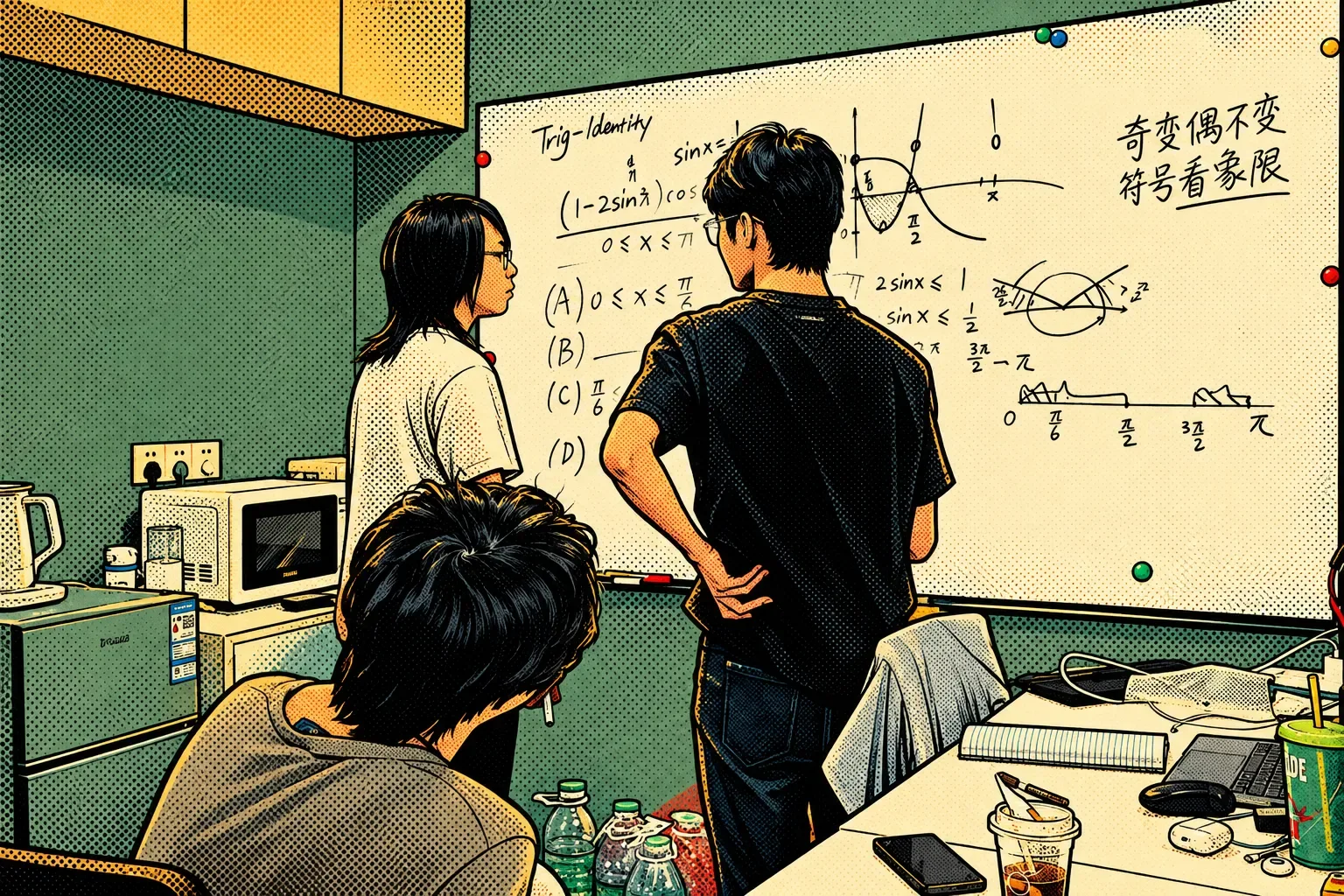
ThenTell me how you got there.Interview prep→Illustration: AI-generated, speech is invented, not our students
What Imperial’s ESAT dashboard shows for EEE
| Group | Offer | Interviewed, unsuccessful | Unsuccessful, not interviewed | Offers among those interviewed |
|---|---|---|---|---|
| Home, non-WP | 64.0% | 23.7% | 12.3% | 73% |
| Home, WP | 46.0% | 30.0% | 24.0% | 61% |
| Overseas | 16.0% | 1.9% | 82.1% | 89% |
| All | 26.3% | 7.4% | 66.3% | 78% |
Source: Imperial, "ESAT scores: applicant outcomes - 2025 entry cycle", Electrical and Electronic Engineering. The final column is our calculation: offers ÷ (offers + interviewed but unsuccessful).
The finding that matters most for overseas applicants
Mean marks by outcome (raw, maximum 27)
| Group | Offer | Interviewed, unsuccessful | Not interviewed |
|---|---|---|---|
| Overseas | 19.8 | 14.0 | 11.7 |
| Home, non-WP | 14.2 | 11.3 | 2.0 |
| Home, WP | 12.2 | 11.2 | 1.1 |
| All | 16.6 | 11.8 | 11.2 |
Imperial does not say how the three module marks are combined; since the maximum equals one module’s length (27 questions), the figure is best read as a per-module average. The very low Home "not interviewed" means suggest that group includes incomplete sittings, and we would not draw conclusions from them.

Part 2 of 3
Sections 05 to 08
Reading your own score now
Save all three modules.
Estimate raw marks.
Use the Overseas column.
Prepare as if invited.
Five misreadings we see after results day
Assuming a high score guarantees an interview
Applying to the BEng because it looks easier
Reading silence in December as rejection
Treating the interview as a formality
What applicants have reported
| Cycle | Applicant report | Source |
|---|---|---|
| 2027 entry | An applicant with 3.4 (Maths 1), 2.6 (Maths 2) and 4.4 (Physics) asked whether contextual status could still lead to an interview. The reply: there is no published cut-off and the application is read as a whole. | TSR · Nov 2026 |
| 2026 entry | An applicant predicted four A*s with an ESAT average of 5.05 reported receiving an interview invitation. | TSR · Nov 2025 |
| 2025 entry | An applicant with a 7.4 average and a Cambridge Engineering offer had no EEE interview by February; another reported second-hand that an 8 average had not been invited. | TSR · early 2025 |
| 2025 entry | Several applicants were told their application was "on hold" pending a February interview round. One received an invitation on 13 February for an interview on 18 February. | TSR · Feb 2025 |
| 2025 entry | One interviewee described the interview as "not a proper academic assessment", more a check on suitability and enthusiasm. | TSR · 2025 |
| 2024 entry | An applicant placed on hold was interviewed on 4 March and later received an offer. | TSR · 2024 |
| 2018 entry | The first 10 to 15 minutes covered the personal statement, followed by A-level mathematics: sketching the graph of a gradient, explaining what a complex number is. Format "depending on who is your interviewer". | TSR · 2017 |
The Student Room threads 7699183, 7642236, 7547738, 7549076, 7426851, 7287098 and 4429420, read 18 November 2026. Scores are as reported by posters and cannot be checked.
The interview: what the department says
Invitation
You and your statement
Problem solving
Teamwork and time
What the problem-solving part feels like: one original example
Worked example · Frontier ACE
- 1
Fix what is conserved
Charge is conserved on the isolated pair. Before: Q = CV = 100 µF × 10 V = 1.0 mC. - 2
Find the final state
The charge spreads over 2C, so each capacitor ends at V = Q / 2C = 5 V. - 3
Compare energies
Before: ½CV² = ½ × 10⁻⁴ × 100 = 5.0 mJ. After: 2 × ½ × 10⁻⁴ × 25 = 2.5 mJ. Exactly half has gone. - 4
Account for it
It is dissipated in the resistance of the wire as current flows. The striking part is that the loss is 2.5 mJ whatever the resistance: a smaller resistance gives a larger, shorter current pulse, and the I²R energy comes out the same. With almost no resistance, the energy leaves as radiation and oscillation in the loop’s inductance.
Part 3 of 3
Sections 09 to 11
Four practice questions, and what to revise
Question 1 · Mathematics
- Step 1. y starts at 0, rises, then decays to 0 because the exponential eventually beats the linear term.
- Step 2. y′ = (1 − x)e−x: equal to 1 at the origin, zero at x = 1 (the maximum, y = 1/e), negative beyond.
- Step 3. y″ = (x − 2)e−x, so the gradient is most negative at x = 2 and then returns towards zero from below.
- Step 4. It is the impulse response of a critically damped second-order system, such as a suitably chosen RLC circuit: rises quickly, settles without overshoot.
Question 2 · Mathematics and circuits
- Step 1. Define it as a + jb, then give the geometric reading: a point, or an arrow, in a plane. Multiplying by j rotates by 90°.
- Step 2. Euler’s formula, ejθ = cos θ + j sin θ, turns a rotating arrow into a sinusoid.
- Step 3. For sinusoidal signals, differentiation becomes multiplication by jω. Differential equations for circuits become algebra.
- Step 4. So a capacitor has impedance 1/(jωC): the j says current leads voltage by 90°, and the ω says it passes high frequencies more easily.
Question 3 · Estimation
- Step 1. 5 Ah × 3.85 V ≈ 19 Wh ≈ 69 kJ.
- Step 2. Ideal time at 20 W: about one hour. With charger and battery efficiency of around 85–90%, a little more.
- Step 3. Lithium-ion cells charge at constant current until they approach their maximum voltage, then at constant voltage with a falling current. The last fifth takes disproportionately long.
- Step 4. Faster charging means larger current, more I²R heating and faster degradation of the cell. The limit is chemistry and heat, not the charger.
Question 4 · Motivation
- Step 1. Use the department’s own distinction: EEE runs from the physics of electrons and electromagnetism to transistors, sensors, wireless communication and power systems; EIE puts more weight on software and information.
- Step 2. Anchor your choice in one thing you have built or taken apart, and say which layer of it held your attention: the hardware, the signal, or the code.
- Step 3. Show you know the structure: a common first year, with specialisation from the second year. Say what you would want to test before committing.
- Step 4. Name one strand of the department’s work you would like to learn more about, and why, without reciting a research page.
What to revise for the Imperial EEE interview
| Area | Why | Topics |
|---|---|---|
| 01 · Mathematics | An A* in Maths is required, and reported questions are mathematical | Curve sketching and gradients · exponentials and logarithms · complex numbers · small-angle and series approximations |
| 02 · Circuits and fields | A-level Physics is the base; the course builds on it from the first term | Kirchhoff’s laws, potential dividers · capacitors, RC charging and energy · electric and magnetic fields, induction |
| 03 · Engineering judgement | Problem-solving questions reward method over recall | Estimation and units · efficiency and power loss · stating assumptions aloud |
| 04 · Your own application | The department warns you may be asked about your statement | Each project, step by step · your Extended Project, if any · one teamwork example; one on time management |
Timeline: from results day to a decision, 2026–27
October ESAT results16 Nov
Autumn interview round
January ESAT booking closes21 Dec
January ESAT sitting
UCAS deadline13 Jan
January ESAT results8 Feb
Spring interview round
DecisionsEnd of March
Checklist: the two weeks before your interview
- Reread your personal statement and be able to explain every project in it, step by step, including what went wrong.
- Prepare a two-minute answer to "why EEE (or EIE), and why Imperial" that refers to the course structure, not to rankings.
- Prepare one teamwork example and one example of managing your time, as the department asks.
- Work through the four questions above aloud, with someone interrupting you at least once per question.
- Revise curve sketching, complex numbers and RC circuits until you can explain them without notes.
- Test Microsoft Teams on the device you will use, with a camera at eye level and a pen and paper to hand.
- Convert the interview time to your time zone and write it down in both.
- Prepare one genuine question for the interviewer about the course.
Sister site
Practise saying the thinking out loud
Frontier ACE is Frontier Academy’s AI interview practice site for Oxford, Cambridge and Imperial applicants. It runs timed video-style practice and mock interviews, then scores each attempt on five dimensions. Use it to rehearse the conversation, then come back to the subject problems here.
Frontier ACE is a Frontier Academy site. Links open in a new tab and are tagged as referrals.
The pages this article points to
Official sources
8 official sources (click to view)
- Imperial College London, Undergraduate Admissions Statistics 2021–2025 (sheets 1 Admission Rate, 3 Gender, 4 Nationality)
- Imperial College Statistics Guide 2025–26 (Planning and Insight Division): undergraduate applications and admissions by department and fee status; student numbers; staff ratios; degrees awarded
- Imperial: Understanding your ESAT and TMUA scores, including the dashboard "ESAT scores: applicant outcomes - 2025 entry cycle"
- Imperial EEE: Applications, Admissions Test and Interviews
- Imperial: MEng Electrical and Electronic Engineering, 2027 entry
- Imperial EEE undergraduate booklet (2026)
- Imperial: Engineering and Science Admissions Test (ESAT)
- UAT-UK, ESAT results and key dates for 2027 entry
Frequently asked questions
What ESAT score do you need for Imperial EEE?
Does Imperial EEE interview every applicant?
When are Imperial EEE interviews held?
Is the Imperial EEE interview technical?
Is the BEng easier to get into than the MEng?
How many applicants from China apply to Imperial EEE?
My application is "on hold". Have I been rejected?
UAT-UK, Pearson, OCR, the University of Cambridge, Imperial College London and other names and logos belong to their respective owners.
Turn reading into practice
Timed exam-style practice with worked solutions, and original interview questions with what each one tests.