Imperial Chemistry

No test for Imperial Chemistry? Then the interview is the final stage: 20 minutes, two interviewers, one unseen problem

5 sections628 words4 min read4 official sources

Imperial Chemistry at a glance

Admissions test
None
Shortlisted
About 1,100 of 2,150 applicants in 2025-26
Interview
Online on Teams, about 20 minutes, two interviewers
When
Early November to mid February
Grades
Typical A*AA to A*A*A with A* Chemistry; minimum AAA; IB 38
UCAS code
F103 (MSci, four years)

The one thing to do before the interview: for every chemistry topic in your statement, prepare one explanation that goes a level deeper, because the middle of the interview will probe them.

Imperial Chemistry has no admissions test: the UCAS form decides the shortlist, then two interviewers spend about 20 minutes on Teams, from motivation to unseen problems. In 2025-26, 615 of about 2,150 applicants got offers. What counts is keeping up when guided. See the Imperial interviews overview.

In short

  1. 01Stage one is the written application: grades, subject combination, statement and reference are all read, and motivation for Chemistry weighs heavily.
  2. 02Subject choice affects the shortlist: without Biology, Physics or Further Maths as the third subject, the department says you are much less likely to be shortlisted.
  3. 03The interview moves from motivation and your statement to unseen problems; the department says it will teach you something new, and not every answer needs to be right. Keeping up with the guidance is what counts.
  4. 04The department says there are no trick questions and an obvious answer may simply be right: we suggest giving it first, then saying how you would check it.
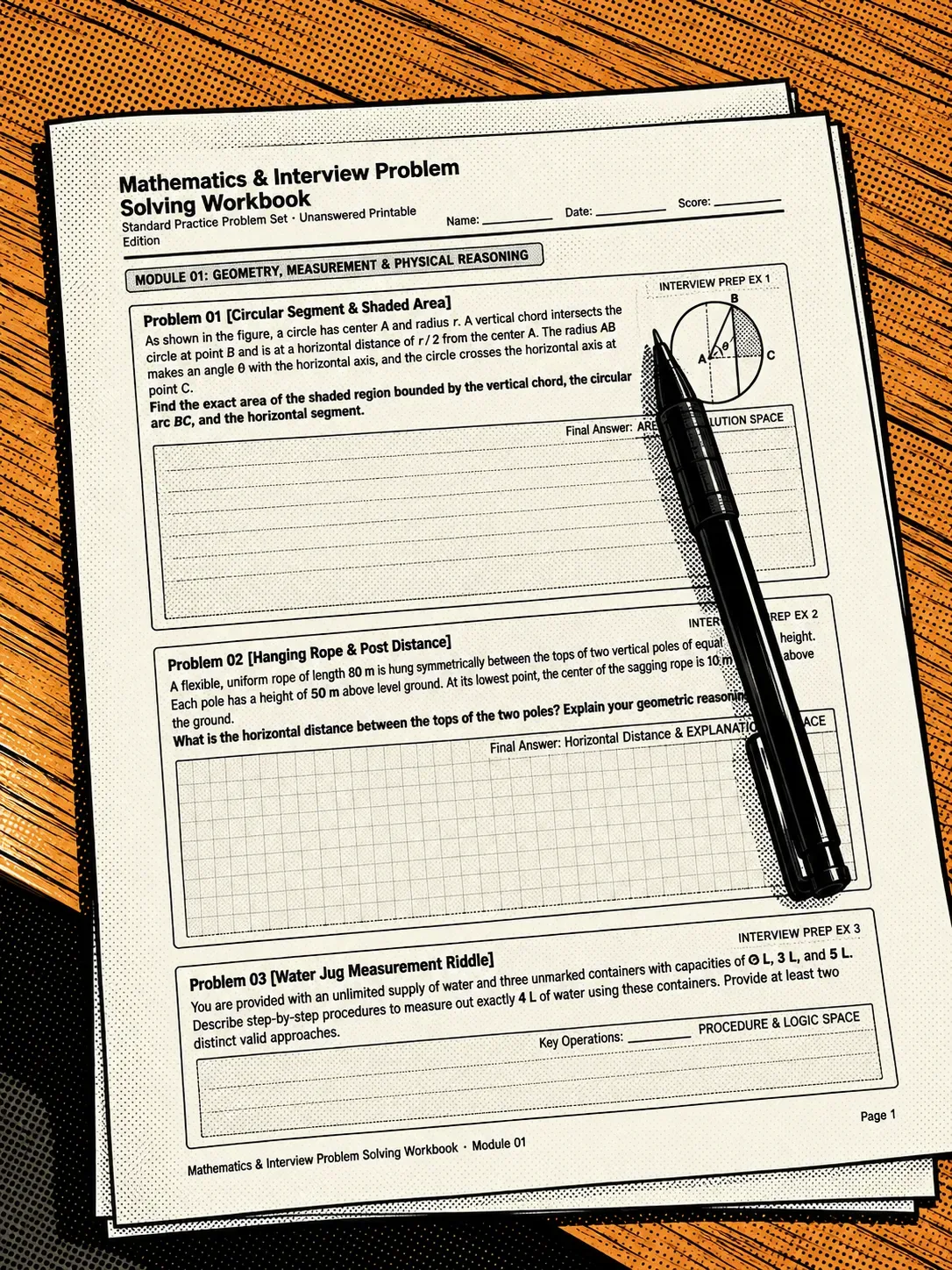
A maths and interview practice worksheet with a pen on a desk
A maths and interview practice worksheet with a pen on a desk · Illustration · AI-generated
Part 1

Two stages: the form gets you shortlisted, the interview gets the offer

~2,150

applicants in 2025-26

~1,100

shortlisted for interview

615

offers after interview (about 30% of applicants)

230

planned intake for 2027

Course

Four-year MSci, UCAS F103

Five-year and research-abroad variants available

Typical A-level offer

A*AA to A*A*A

A* in Chemistry; AAA is the contextual minimum; no offers on four subjects

Subjects

Chemistry, Maths and a third subject

Biology, Physics or Further Maths preferred as the third

IB

Typically 39 to 40 points

Minimum 38 points

01By 13 January

UCAS application

The 2027-entry deadline is 18.00 UK time on 13 January 2027; no Extra or Clearing.
02Stage 1

Shortlisting from the form

Grades, subject combination, statement and reference are read in detail. EPQs and work experience are not used to shortlist.
03Early Nov to mid Feb

Stage 2: interview on Teams

Each applicant is seen individually for about 20 minutes by two interviewers, in UK morning and afternoon slots to suit time zones; no offer is made without an interview. Those invited can also join online Q&A sessions with the admissions tutor and current students.
04By mid March

Decision by email

Offers are decided after all interviews, by email by mid March, with UCAS Hub updated by the end of March. Some 2026-27 offers may come earlier.
Guaranteed interview: applicants who meet Imperial’s Widening Participation criteria and are predicted AAA (IB 38, HL666) are guaranteed an interview. Reapplicants who held a Chemistry offer last cycle are not interviewed again.
Part 2

Three parts in twenty minutes, and one practice problem, fully worked

01Opening

Why Chemistry

They look at motivation and enthusiasm, and how you communicate.
02Middle

A topic you know

A topic named in your statement or one you are keen on, followed one level deeper.
03Final part

Unseen problems

Step-by-step questions to see how you learn something new and handle the unfamiliar.
One formula, three boiling points
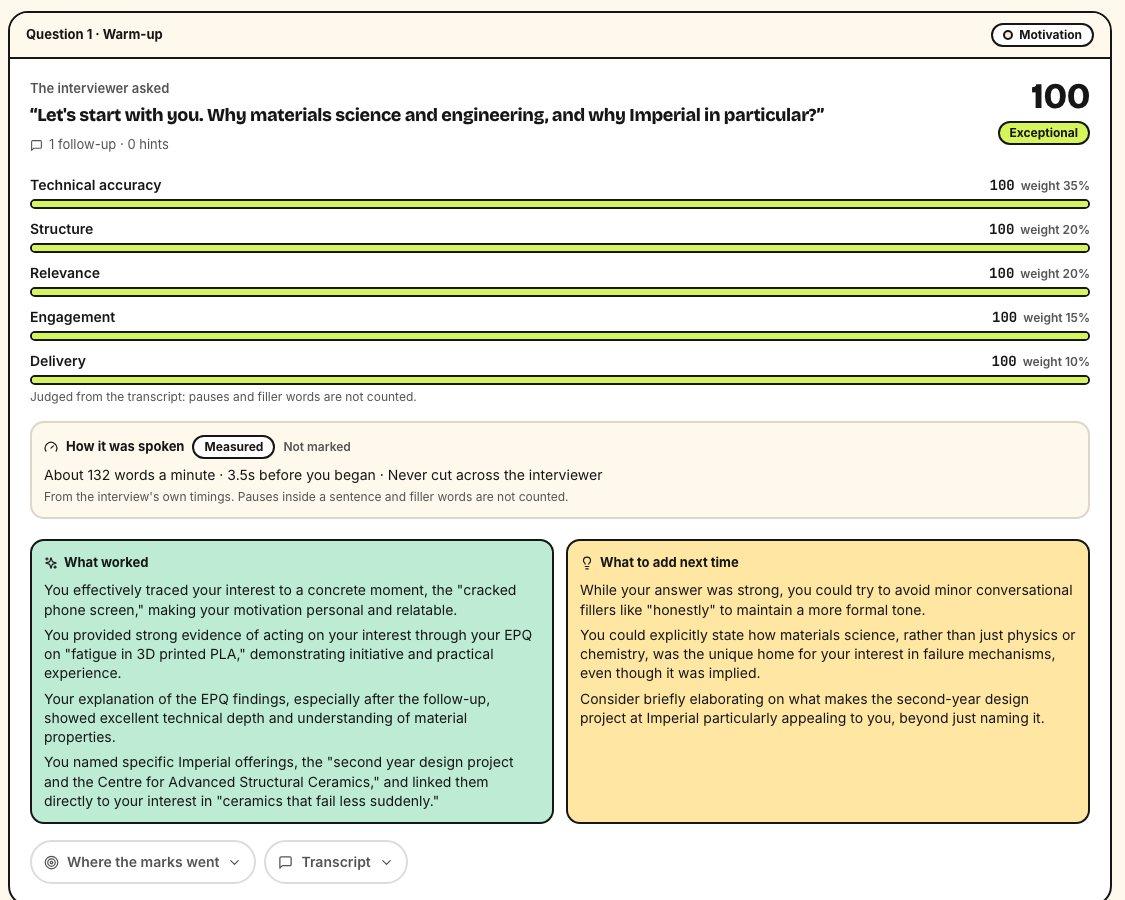
Pentane, 2-methylbutane and 2,2-dimethylpropane all have the formula C₅H₁₂, and boil at about 36 °C, 28 °C and 10 °C. Why does more branching lower the boiling point? Yet 2,2-dimethylpropane melts at about −17 °C, far above pentane at about −130 °C. How can that be?
Frontier ACE mock practice4 steps + answer
  1. 1
    Find what is the same
    Same mass, no polar groups: only dispersion (London) forces act between molecules, so shape must be the difference.
01

Silence for fear of being wrong

Wrong
Stopping when unsure and waiting to be told.
Right
Say your guess and why; the interviewers will guide you.
Spot it:
The department says it does not expect every answer to be right and will guide you.
02

Overthinking a simple question

Wrong
Assuming an obvious answer must be a trap.
Right
Give the obvious answer, then say how you would check it.
Spot it:
The department says there are no trick questions.
Revise

What to revise for Imperial Chemistry

Our recommended revision list, built from the admissions-test syllabus and the kinds of problems interviews use.

01

Structure and bonding

Unseen problems can start from molecular shape and intermolecular forces.

  • VSEPR and bond angles
  • Dispersion, dipoles and hydrogen bonds
  • Lattices and melting points
02

Energetics and equilibrium

Why reactions happen and how far they go is the core of physical chemistry; practise predicting, then explaining.

  • Enthalpy change and activation energy
  • Le Chatelier’s principle
  • Acids, bases and buffers
  • Rates of reaction
03

Organic mechanisms

Mechanisms show whether you are recalling or reasoning.

  • Nucleophilic substitution and elimination
  • Curly arrows and electron flow
  • Reactivity of functional groups
04

Maths in chemistry

A-level Maths is required; logs, ratios and estimates come up.

  • pH and logarithms
  • Moles and order-of-magnitude estimates
  • Exponential decay in first-order reactions
05

Your personal statement

The middle of the interview takes a topic you wrote about one level deeper.

  • Explain the chemistry behind every book and experiment you mention
  • One chemistry topic you genuinely care about
  • Links between chemistry and your other subjects
Practise

4 practice questions for this course

Exclusive questions in the style of this interview. Talk each one through out loud first, then open the hints one at a time.

01Question 1New for this course
A few drops of hydrochloric acid in pure water drop the pH a lot, but in the same volume of blood the pH barely moves. Why? Is there a limit to this protection?
Frontier ACE mock practice3 steps
  1. What it tests
    Explaining buffering through equilibrium: not reciting “blood is buffered”, but saying what takes up the added H⁺ and which way the equilibrium shifts. The second half checks whether you volunteer that buffer capacity is finite and link the chemistry to how the body regulates itself.
  2. 1
    Step 1
    Start with the control: “In pure water nothing takes up the added H⁺, so its concentration rises by orders of magnitude and the pH drops several units.”
Water is a liquid at room temperature, but hydrogen sulfide is a gas, even though the molecules have a similar shape. Why?
Frontier ACE mock practice3 steps
  1. What it tests
    This tests intermolecular forces and hydrogen bonding. The key is not that water is heavier, but that oxygen’s electronegativity lets water molecules form strong hydrogen bonds.
  2. 1
    Step 1
    Both are bent molecules, but oxygen is strongly electronegative, so O–H bonds are very polar and a lone pair on one molecule hydrogen-bonds to an H on another.
A reaction releases energy overall, yet it needs heating to get started. How is that possible?
Frontier ACE mock practice3 steps
  1. What it tests
    This tests the difference between activation energy and thermodynamics. An exothermic reaction means the products are more stable; needing heat means there is an energy barrier between reactants and products.
  2. 1
    Step 1
    Draw the energy profile: reactants sit above products, so ΔH is negative, but the reactants must first climb over a higher transition state.
Predict the shapes of methane, ammonia and water. All three have four electron pairs around the central atom, so why are the bond angles different?
Frontier ACE mock practice3 steps
  1. What it tests
    This tests VSEPR and lone-pair repulsion. The interviewer wants to see that electron-pair geometry and molecular shape are not the same thing.
  2. 1
    Step 1
    Methane has four bonding pairs, so it is tetrahedral with a bond angle of 109.5°.
Checklist

The two weeks before your interview

0 of 9 done

Progress is saved in this browser only.

Question set

Chemistry interview questions

Original questions with full walkthroughs

5questions

Each one shows what the interviewer is testing, the steps to say out loud and the likely follow-up.

Open the question set
  1. 01Water is liquid, hydrogen sulfide is gas
  2. 02An exothermic reaction that needs heating first
  3. 03Separating sand, salt and iron filings
  4. 04Salt on icy roads, and its limit

Frontier ACE · how it works

Rehearse the Imperial Chemistry interview on Frontier ACE

Imperial Chemistry interview questions
40+
Imperial Chemistry interview questions
of real interview questions covered
90%+
of real interview questions covered
mock interviews with follow-ups
1v1
mock interviews with follow-ups
scoring dimensions after each answer
5
scoring dimensions after each answer
frontierace.ai
The Frontier ACE interviewer
Same university

More Imperial interviews

Sources

Official sources

4 official sources (click to view)
FAQ

Frequently asked questions

Is there an admissions test for Imperial Chemistry?
No. The department uses no test; the shortlist comes from the UCAS form, and the offer from the form plus the interview.
How many applicants are interviewed?
In 2025-26 about 1,100 of roughly 2,150 applicants were shortlisted and 615 offers followed interview, about 30% of applicants. The shortlist share varies each year, and the department expects close to 40% for 2027 entry.
How many interviewers are there?
Two: two experienced Chemistry academics, or a senior academic and a researcher, for about 20 minutes. We suggest practising with two people taking turns to ask.
Can I apply to other Imperial departments as well?
You can, but the department says applicants who also apply to Biochemistry, Chemical Engineering, Materials or Biomedical Engineering, with a statement focused elsewhere, are less likely to be shortlisted. Separately, it recommends applying for only one of its Chemistry degrees, since you can transfer in the first two years.

UAT-UK, Pearson, OCR, the University of Cambridge, Imperial College London and other names and logos belong to their respective owners.

Prepare for Imperial Chemistry interview in four weeks

Work through the original subject questions, then rehearse the conversation with FrontierACE. Both are built by Frontier Academy.