- 1Lift equals weightW = 70,000 × 9.8 ≈ 6.9 × 10⁵ N.
Imperial Aeronautical Engineering
What does the Imperial Aeronautics interview test? Not just what you know, but whether you can be coached
Imperial Aeronautics at a glance
- Admissions test
- ESAT Mathematics 1, Mathematics 2, Physics; interview threshold set by the cohort
- Interview
- Microsoft Teams, for UK and overseas applicants alike
- Length
- About 25 to 30 minutes
- When
- Usually November and February, about a week’s notice
- Grades
- Minimum A*A*A or A*AAA; typical A*A*A*; IB typically 43 to 44
- Applications per place
- 11 : 1, UCAS code H401
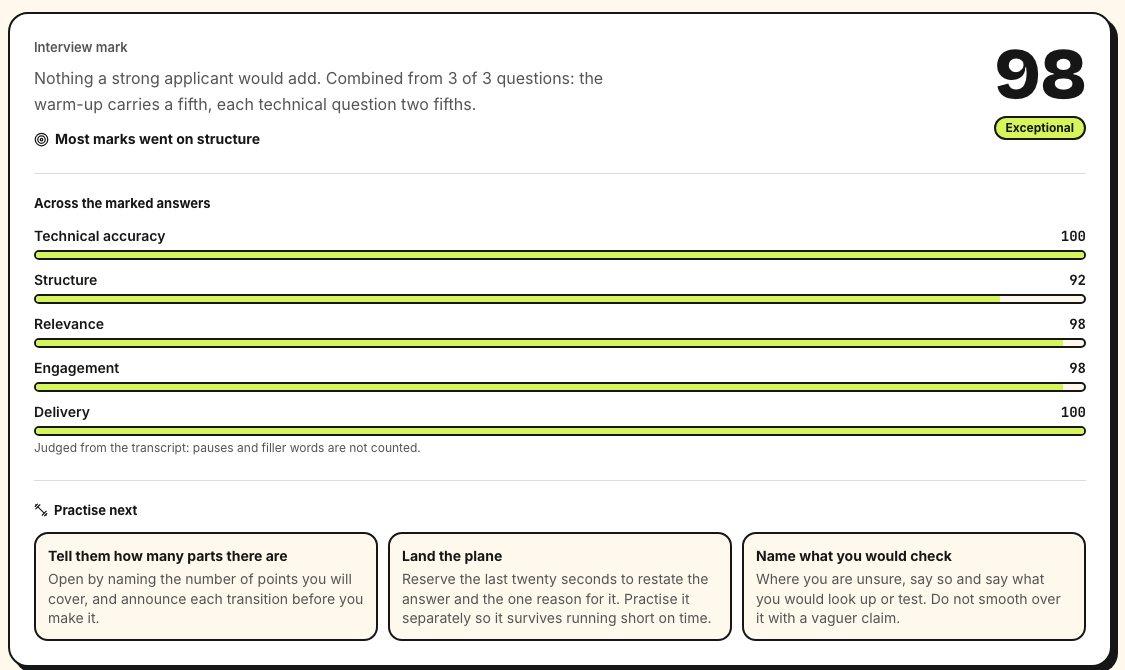
The one thing to do before the interview: record yourself answering “why Aeronautics, why Imperial” on your phone, watch it back, then improve it.
In short
- 01You need an excellent ESAT and UCAS form to be interviewed; the threshold depends on the cohort, and October and January sittings are treated the same.
- 02The department names two kinds of question: motivation (why Aeronautics, why Imperial, an experience from your statement) and a maths, physics or engineering problem.
- 03The problem tests coachability: absorbing new content, trying other angles, and handling counter-questions and new ideas.
- 04Notice is only about a week: we suggest keeping November and February flexible and preparing your statement and motivation answers now.

From application to interview: how Aeronautics selects
Apply to H401
Three ESAT modules
Shortlisted for interview
Teams interview
Decision
Course
Four-year MEng, UCAS H401
At the end of year two, if on track for a 2:1, you may apply for Aeronautics with Spacecraft Engineering; at the end of year three, for a Year Abroad or Year in Industry
Typical A-level offer
A*A*A* with three, A*A*AA with four
A* in Maths; Physics A* with three A-levels, at least A with four
IB
Typically 43 to 44 points
Minimum 40 with 7 in HL Maths and Physics
Recommended subject
Further Mathematics
Recommended but not essential
| Motivation questions | Critical thinking questions | |
|---|---|---|
| What each part covers | Motivations and academic ambitions | Critical thinking, problem solving, communication and coachability |
| Department’s examples | Why Aeronautical Engineering? Why Imperial? An interesting experience from your statement (internship, online course or book). | Typically a maths, physics or engineering question. |
| What they assess | Whether you will enjoy the course, whether your interests fit, and whether you communicate clearly | Your approach, coachability, multiple perspectives, handling counter-questions and new ideas |
| How to prepare | Structure answers with STAR (Situation, Task, Action, Result), and record yourself | Talk through your method, stating assumptions and why you chose your approach |
What a critical thinking question feels like: one practice problem, fully worked
Giving up on an unfamiliar formula
Folding at the first pushback
What to revise for Imperial Aeronautics
Our recommended revision list, built from the admissions-test syllabus and the kinds of problems interviews use.
Mechanics and motion
The problem is usually maths, physics or engineering, and flight starts with forces.
- The four forces: lift, weight, thrust, drag
- Uniform acceleration and take-off runs
- Circular motion and turning
- Momentum and jet propulsion
Fluids and air
Lift, drag and altitude all come back to air density and pressure.
- Pressure, density and altitude
- Bernoulli: intuition and limits
- Drag and speed squared
Orbits and spaceflight
You may move to Aeronautics with Spacecraft Engineering after year two, so if space interests you, prepare it too.
- Gravitation and orbital speed
- Escape velocity
- Why rockets use stages
Mathematics
Two ESAT modules are maths, and the problems rely on algebra and estimation.
- Rearranging and proportional reasoning
- Trigonometry and vectors
- Estimation and orders of magnitude
- Basic calculus
Motivation and experience
The department’s sample motivation questions are why Aeronautics, why Imperial, and an experience from your statement.
- One experience told with STAR
- How a maths or physics topic you love links to Aeronautics
- If you also applied for Mechanical, how the two connect
5 practice questions for this course
Exclusive questions in the style of this interview. Talk each one through out loud first, then open the hints one at a time.
- What it testsA classic trade-off question: air density affects drag, lift and the engines all at once, so “less drag up high” is only half an answer. The interviewer wants several competing factors weighed together and a conclusion with limits, the “multiple perspectives” the department describes.
- 1Step 1Give the first reason: “Thinner air at altitude means less drag at the same speed, so less fuel.”
- What it testsThe first part is a free ratio; the real test is the next two: seeing from the force geometry that the glide ratio equals lift over drag, then separating airspeed from ground speed and height from energy. Mix those up and the answer goes wrong, so the problem shows clearly whether your concepts are sharp.
- 1Step 1Bank the first part: “In still air the distance is 1000 × 40 = 40 km.”
- What it testsMomentum and energy together: the rotor pushes air down, thrust equals the momentum given to the air each second, and power equals the kinetic energy given each second. It is the classic aero interview problem of using A-level mechanics on a real aircraft, and it explains why rotors are so large.
- 1Step 1State the model: treat the rotor as a disc of area A accelerating still air to a downward speed v; take g = 10, so thrust F = weight = 20000 N; air density ρ = 1.2 kg/m³; A = π × 5² ≈ 78.5 m².
- What it testsDrag F = ½ρC_dAv², power P = Fv, and the resulting v³ law. The interviewer wants a messy problem split into a few estimable numbers, ending in a counter-intuitive but useful result: half the speed leaves one eighth of the drag power.
- 1Step 1Assumptions aloud: ρ = 1.2 kg/m³; a family car’s drag coefficient about 0.3; frontal area about 2.2 m² (roughly 1.8 m by 1.4 m, less the corners).
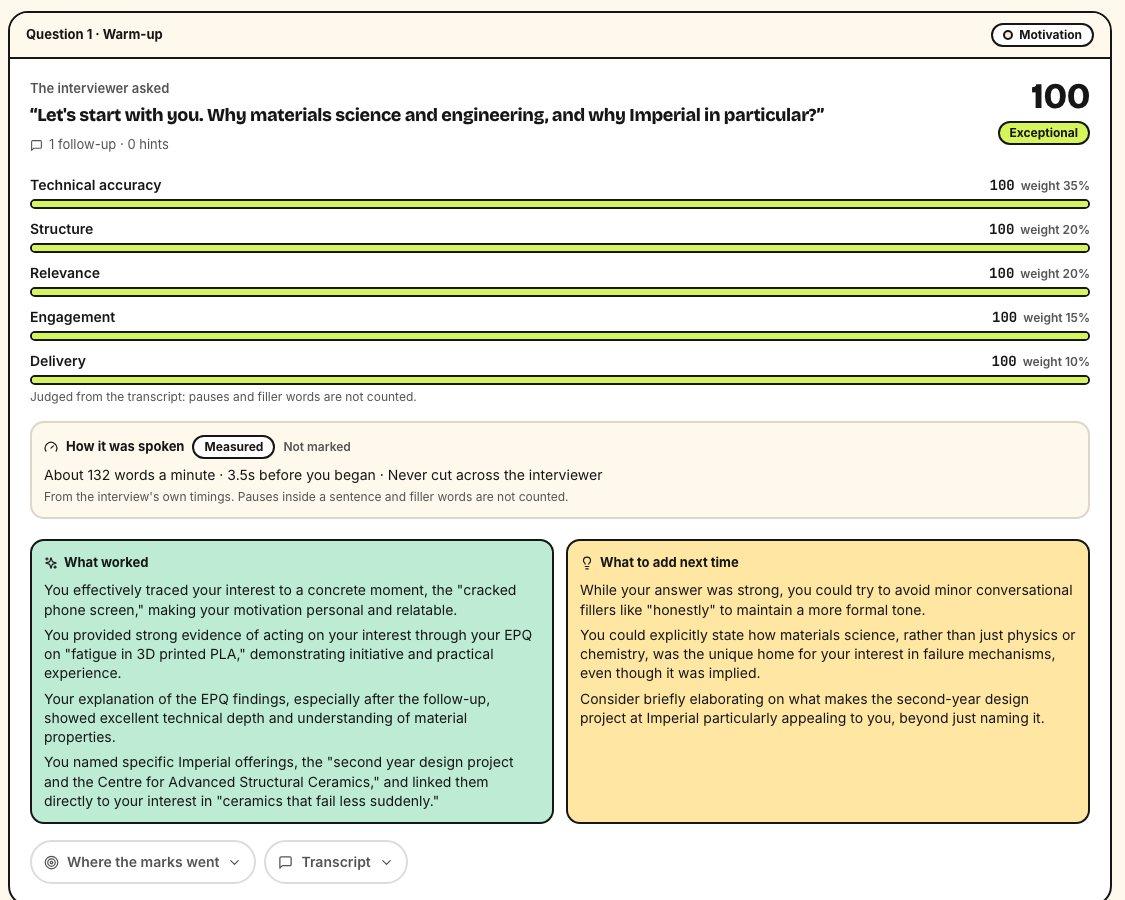
- What it testsThe first part of the Aeronautics interview is motivation and academic ambitions, with examples such as why Aeronautical Engineering and why Imperial, and an interesting experience from your statement, answered with STAR (situation, task, action, result). Mechanical also asks about your interest in engineering. The question checks whether your motivation is a checkable event rather than adjectives.
- 1Step 1Situation and task in a sentence: where and what. For example, “our school club built a radio glider to carry 200 grams, and I owned the wing.”
The two weeks before your interview
0 of 9 done
Progress is saved in this browser only.
Mechanical and Aeronautical Engineering interview questions
Original questions with full walkthroughs
6questions
Each one shows what the interviewer is testing, the steps to say out loud and the likely follow-up.
- 01Will a leaning ladder slip on the floor
- 02Power needed for a helicopter to hover
- 03Drag power for a car at 30 m/s
- 04Water pressure and speed below a tank
Frontier ACE · how it works
Rehearse the Imperial Aeronautics interview on Frontier ACE
- Imperial Aeronautics interview questions
- 40+
- Imperial Aeronautics interview questions
- of real interview questions covered
- 90%+
- of real interview questions covered
- mock interviews with follow-ups
- 1v1
- mock interviews with follow-ups
- scoring dimensions after each answer
- 5
- scoring dimensions after each answer
More Imperial interviews
Official sources
5 official sources (click to view)
- Imperial College London: Aeronautical Engineering MEng course page (2027 entry)
- Imperial Department of Aeronautics: admissions procedure and preparing for interview
- Imperial College London: ESAT dates, booking and format
- Imperial College London: undergraduate interviews (usually November to February)
- Imperial College London: our selection process and decisions
Frequently asked questions
Do overseas applicants travel to London?
What ESAT score gets an interview?
How does the department suggest preparing?
UAT-UK, Pearson, OCR, the University of Cambridge, Imperial College London and other names and logos belong to their respective owners.
Prepare for Imperial Aeronautical Engineering interview in four weeks
Work through the original subject questions, then rehearse the conversation with FrontierACE. Both are built by Frontier Academy.