- 1Divide first100 m is 100,000 mm; at 1 mm a year that is 10⁵ years, a hundred thousand years.
Imperial Earth Science and Engineering
No test at Imperial Earth Science: one conversation that still counts on results day
Imperial Earth Science and Engineering at a glance
- Admissions test
- None
- Interview
- One-to-one discussion with an experienced academic; may be online
- Online slots
- UK morning and afternoon, for other time zones
- What it assesses
- Motivation for earth sciences and future potential
- Minimum
- AAA; IB 38
- Applications per place
- 4 to 5 : 1
The one thing to do before the interview: choose one earth science question that genuinely interests you and practise talking about it for five minutes, including what you do not yet understand.
In short
- 01No test: predicted grades matter but are not the only thing; your statement, references and the interviewer’s comments count too.
- 02It is a discussion, not an exam: the academic wants to see why you want earth sciences and how far you could go.
- 03If you marginally miss your offer, the department looks especially at your interviewer’s comments before confirming a place.
- 04Online interviews run in UK morning and afternoon slots for different time zones; we suggest converting your slot to local time as soon as it arrives and adjusting your sleep around it.

The three degrees and their requirements
| Geology | Geophysics | Earth and Planetary Science | |
|---|---|---|---|
| UCAS codes (BSc / MSci) | F600 / F640 | F662 / F660 | F64B / F647 |
| A level | AAA including at least two of Biology, Chemistry, Geography, Geology, Maths, Physics | AAA with A in Maths and Physics | AAA with A in Maths and in Biology, Chemistry, Geography, Geology or Physics |
| IB | 38, 6 in two of those subjects at HL | 38, 6 in HL Maths, Physics and a third subject | 38, 6 in HL Maths and in HL Biology, Chemistry, Geography, Geology or Physics |
| Applications per place | 4 to 5 : 1 | 4 to 5 : 1 | 4 to 5 : 1 |
Each four-year MSci is also offered with a Year Abroad. The department says the three share a very similar first two years, and you can switch before the spring term of year one if you met the target degree’s original entry requirements.
Interview day: on campus or online
Invitation
Meet the department
Morning and afternoon slots
A discussion with an academic
Comments still count
How the science may come up: one practice problem, fully worked
What to revise for Imperial Earth Science
Our recommended revision list, built from the admissions-test syllabus and the kinds of problems interviews use.
Earth structure and processes
When discussing motivation, explaining how one geological process works persuades most.
- Plate tectonics, earthquakes and volcanoes
- The rock cycle
- Sedimentation and stratigraphy
Physics
Geophysics requires Physics, and seismic waves, gravity and magnetism are read through physics.
- Wave propagation and reflection
- Density, buoyancy and isostasy
- Heat flow and radioactive decay
Chemistry
Minerals, weathering and water chemistry are the other half of geology.
- Minerals and crystals
- Weathering and dissolution
- The carbon cycle
Resources, environment and planets
The department works on water, energy, minerals and planetary science; anchor your motivation in one concrete problem.
- Critical minerals and the energy transition
- Geohazards
- The geology of Mars and the Moon
6 practice questions for this course
Exclusive questions in the style of this interview. Talk each one through out loud first, then open the hints one at a time.
- What it testsThe arithmetic is one step; the real test comes after: whether you list the method’s assumptions unprompted and explain why it is the volcanic rock that gets dated. That is the scientific potential the academic is looking for.
- 1Step 1Calculate and say the logic: “Half left is one half-life, a quarter left is two, so 2 × 1.3 billion = 2.6 billion years.”
- What it testsTwo things: a clean estimate from volume divided by area, and telling ice on land from ice already floating. The second half is a trap; saying sea ice would also raise the sea a lot gives you away.
- 1Step 1State your numbers: “Greenland holds about 3 × 10⁶ km³ of ice; ice is about 0.9 times as dense as water, so that is about 2.7 × 10⁶ km³ of water.”
- What it testsWhether you can reason from observations to a structure nobody can see: the properties of two kinds of seismic wave, the shadow zone as evidence, then an independent line of support. The structure of the answer matters more than recalling 2,900 km.
- 1Step 1Start with the waves: “Earthquakes send out two kinds of body wave. P waves are longitudinal and travel through solids and liquids; S waves are transverse and need shear strength, which liquids lack.”
- What it testsThis is isostasy, the central picture of introductory geophysics: crust floats on mantle like wood on water. It needs only a balance and a linear equation, but the picture must come before the algebra, and the academic watches for a sanity check at the end.
- 1Step 1Picture first: crust floats on denser mantle, and any extra height must be held up by a root reaching down, as a taller iceberg sits deeper. Say “buoyancy balance” before writing anything.
- What it testsThis tests speed, time and distance, then geometric location. The physics is A level; the stretch is explaining why one instrument gives only a distance, why you need at least three, and how the real Earth bends the simple model.
- 1Step 1State the idea: both waves leave together over the same path, the faster arrives first, and the gap grows with distance. “I will call the distance d, write both travel times and subtract.”
- What it testsThis is earth science in the energy transition: half volume estimate, half geological judgement. The test is turning an abstract million tonnes into a block of rock you can picture, then saying what a safe reservoir needs and where the biggest risk lies.
- 1Step 1Volume first: a million tonnes is 10⁹ kg; divided by 700 kg/m³ that is about 1.4 × 10⁶ m³ of CO₂. Note why it is so dense: under deep pressure it behaves much more like a liquid than the gas we know.
The two weeks before your interview
0 of 9 done
Progress is saved in this browser only.
Earth Science interview questions
Original questions with full walkthroughs
6questions
Each one shows what the interviewer is testing, the steps to say out loud and the likely follow-up.
- 01Why earth science, and which branch
- 02How deep a 3 km mountain’s root goes
- 03Locating an earthquake from P and S waves
- 04How long a chemical leak takes to arrive
Frontier ACE · how it works
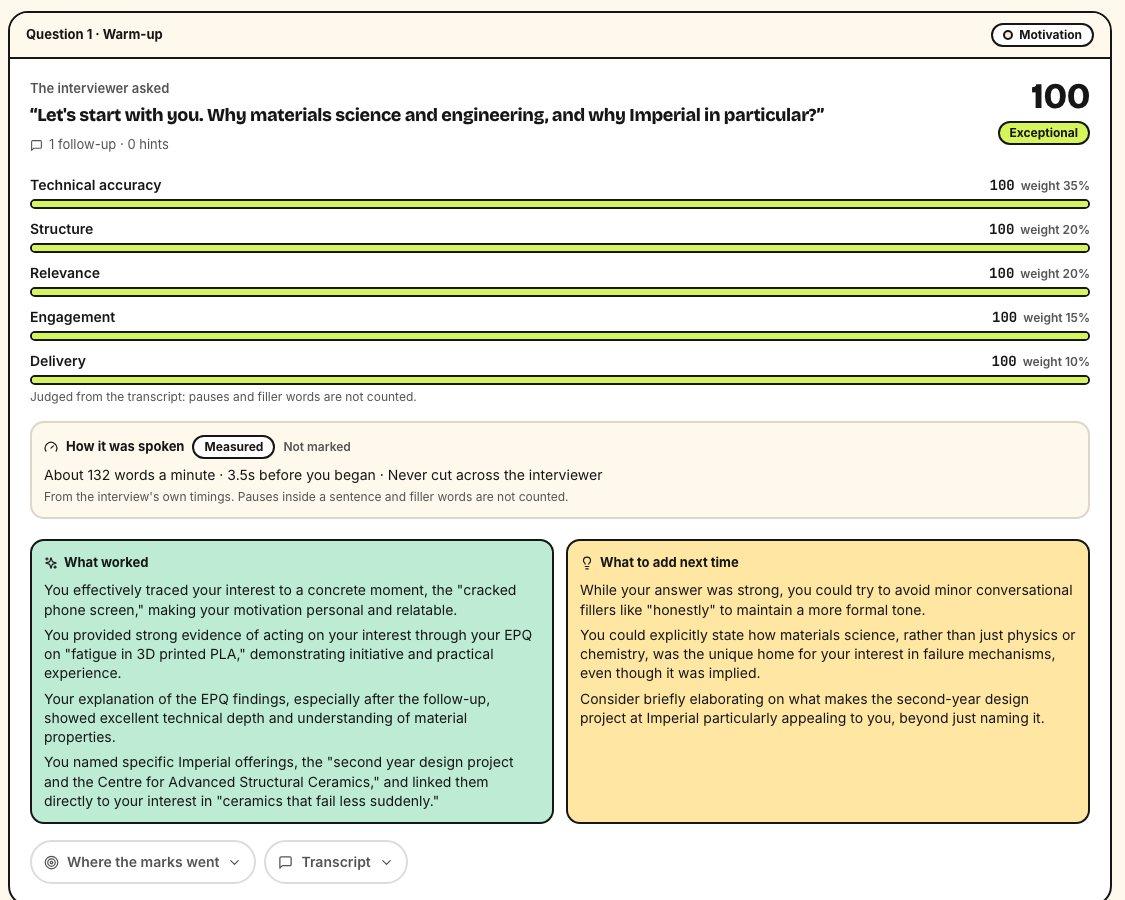
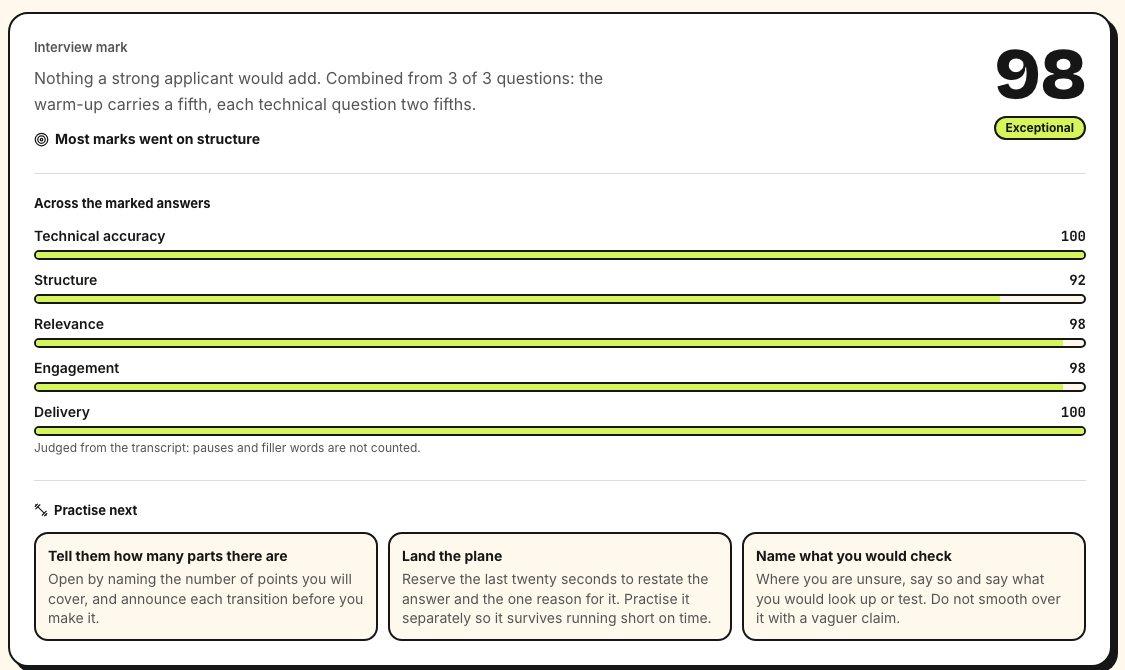
Rehearse the Imperial Earth Science interview on Frontier ACE
- Imperial Earth Science interview questions
- 40+
- Imperial Earth Science interview questions
- of real interview questions covered
- 90%+
- of real interview questions covered
- mock interviews with follow-ups
- 1v1
- mock interviews with follow-ups
- scoring dimensions after each answer
- 5
- scoring dimensions after each answer
More Imperial interviews
Official sources
6 official sources (click to view)
- Imperial College London: Geology MSci course page (2027 entry, selection and interview)
- Imperial College London: Geophysics MSci course page (2027 entry)
- Imperial College London: Earth and Planetary Science MSci course page (2027 entry)
- Imperial Department of Earth Science and Engineering: undergraduate degrees
- Imperial College London: which departments use an admissions test
- Imperial College London: undergraduate interviews (usually November to February)
Frequently asked questions
Is there an admissions test for Imperial Earth Science?
Is the interview online or on campus?
Will the interview test a lot of geology?
What if I narrowly miss my offer?
UAT-UK, Pearson, OCR, the University of Cambridge, Imperial College London and other names and logos belong to their respective owners.
Prepare for Imperial Earth Science and Engineering interview in four weeks
Work through the original subject questions, then rehearse the conversation with FrontierACE. Both are built by Frontier Academy.