Imperial Design Engineering
Imperial Design Engineering: 20 minutes, and the last two are for your work
Imperial Design Engineering at a glance
- Admissions test
- ESAT: Maths 1 and Maths 2 only
- Interview
- Microsoft Teams, around 20 minutes, mostly discussion
- Your own work
- At the end, 2 minutes maximum, screen-sharing enabled
- When
- Beginning of November to mid-March, about a week’s notice
- Minimum
- A*AA with A* in Maths; IB 39 to 40
- Applications per place
- 7 : 1 (2025)
The one thing to do before the interview: pick one piece of work and rehearse it against a timer until the two minutes cover the problem, one decision and one failure.
In short
- 01The interview tests design, technical and maths skills plus motivation, and it is largely discussion; we suggest keeping pen and paper to hand and sketching as you think.
- 02The work slot is two minutes at most and no formal portfolio is required: prototypes, works in progress or sketches, shared on screen or held to the camera.
- 03Only the strongest applicants on UCAS and ESAT are interviewed, and only once the ESAT score has arrived.
- 04Suspected use of generative AI in the interview, such as reading from a screen or showing uncredited AI-made work, may lead to rejection.

Course and entry requirements
Course
Dyson School of Design Engineering, four-year MEng
UCAS code 28G3
A level
A*AA with an A* in Maths
A in two further subjects; the typical offer is also A*AA
IB
39 to 40 points
7 in HL Maths, 6 in another HL subject
Subjects
Maths is the only compulsory A level
Further Maths, Design Technology, Computing and Art all strengthen an application
Application timeline: from the ESAT to a decision
ESAT Maths 1 and Maths 2
Shortlisting
Interview on Teams
Final decision
Design
How you frame a problem and make trade-offs
Prepare: pick an everyday object, name one flaw and how you would fix it.
Technical
Feel for forces, materials and mechanisms
Prepare: moments, levers and simple structures, explained over a force diagram.
Maths
The interview tests maths skills
Prepare: the ESAT Maths 1 and 2 range, worked cleanly without a calculator.
Motivation
Why Design Engineering
Prepare: talk about something you have made, not a recited paragraph.
Choosing what to show in two minutes
Hiding AI use
Letting maths slip in a gap year
What a design and maths question feels like: one practice problem, fully worked
- 1Find the pivotIf the lamp tips, it pivots about the edge of the base nearest the head. Take moments there: the base’s weight acts at the centre with arm r; the head’s arm is 0.4 − r.
What to revise for Imperial Design Engineering
Our recommended revision list, built from the admissions-test syllabus and the kinds of problems interviews use.
Mathematics
An A* in Maths is the one compulsory requirement and the interview tests maths skills; for gap-year applicants the school says maths is tested rigorously.
- Sketching and transforming graphs
- Trigonometry and geometry (area, similarity, optimisation)
- Optimisation with derivatives
- Estimation without a calculator
Mechanics and structures
The interview tests technical skill, and forces and stability make a good way in.
- Moments and tipping
- Tension, compression and triangulation
- A feel for strength and stiffness
Design thinking
For design skill, interviewers want to see how you frame a problem and trade off.
- Users and context of use
- Constraints, trade-offs and iteration
- Testing ideas with prototypes
Making
The school calls the course extremely hands-on and encourages making; explaining how you built something proves interest best.
- What 3D printing and laser cutting can and cannot do
- What you found taking an appliance apart
- CAD modelling
The two-minute showcase
The showcase is two minutes at most, so rehearse it.
- The problem in one sentence
- One key decision and one failure
- What the next version would change
4 practice questions for this course
Exclusive questions in the style of this interview. Talk each one through out loud first, then open the hints one at a time.
- What it testsOne question tests two things: breaking an everyday failure into its mechanics (technical), then turning it into a design trade-off (design). What interviewers most want to hear is you naming the cost of your fix unprompted, not just a fix.
- 1Step 1Explain the cause while sketching: “Wind gets under the canopy, so the pressure below is higher than above. The net force pushes up on the slender ribs; once they bend or the joints reverse, the umbrella flips.” Draw a side view marking the pressure difference and the loaded ribs.
- What it testsTurns a familiar choice into geometry and moments: three points define a plane, so three legs never rock on uneven ground, but the edges of the support polygon sit closer to the centre, so it tips more easily. The interviewer wants “stable” split into two meanings you can calculate.
- 1Step 1Split “stable” in two: not rocking and not tipping. Three legs always land on three points and never rock; four on uneven ground leave one leg in the air and rock, which is why café tables get folded paper under them.
- What it testsLinks human-centred design with torque and friction: the difficulty is not just strength but gripping hard enough for friction while also turning. Find the bottleneck and the design follows. The interviewer will also notice whether you think of asking real users.
- 1Step 1Find the force needed: torque = force × radius, so the tangential force at the rim is 2 / 0.035 ≈ 57 N. It is carried by friction; with a hand-to-lid coefficient of about 0.5, the grip squeeze must be at least 57 / 0.5 ≈ 114 N.
- What it testsThe School says a portfolio is optional but you may show prototypes, work in progress or sketches with screen-sharing, for two minutes at most per the course page. This checks whether you can deliver problem, process and reflection in very little time, rather than a polished render. Unfinished, flawed work is often easier to talk about.
- 1Step 1First 20 seconds: the problem and the user, who it is for and what it fixes. One sentence, no backstory.
The two weeks before your interview
0 of 9 done
Progress is saved in this browser only.
Design Engineering interview questions
Original questions with full walkthroughs
6questions
Each one shows what the interviewer is testing, the steps to say out loud and the likely follow-up.
- 01Redesigning a bus stop for 40 °C summers
- 02Three legs or four for a stool
- 03A jar opener for people with weak hands
- 04A pot that waters itself for two weeks
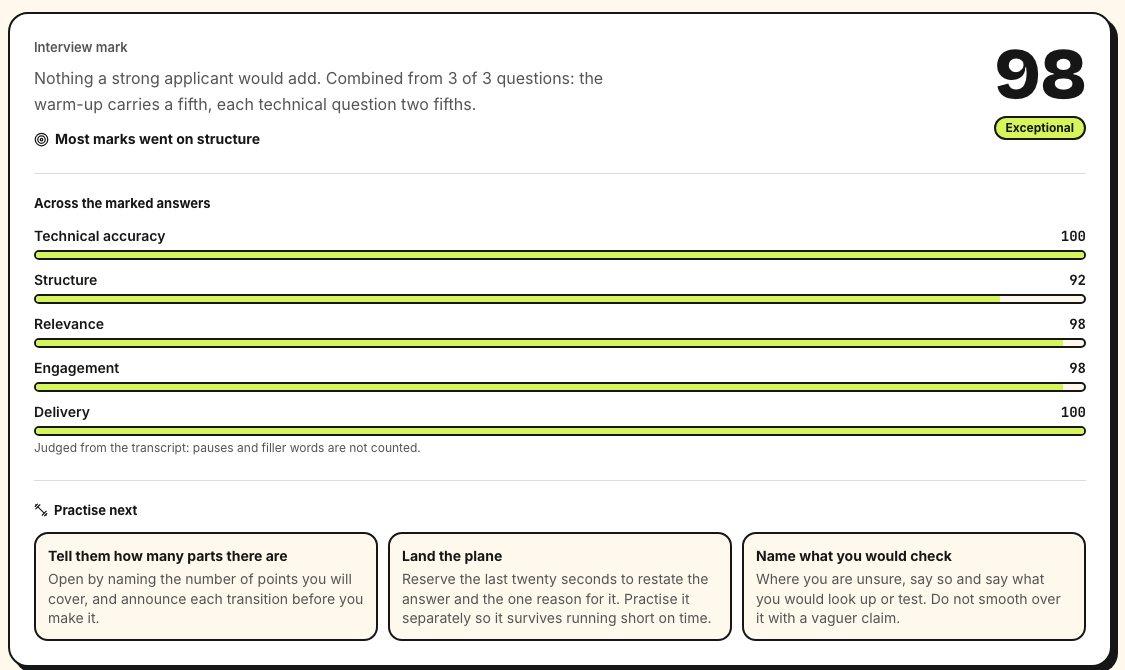
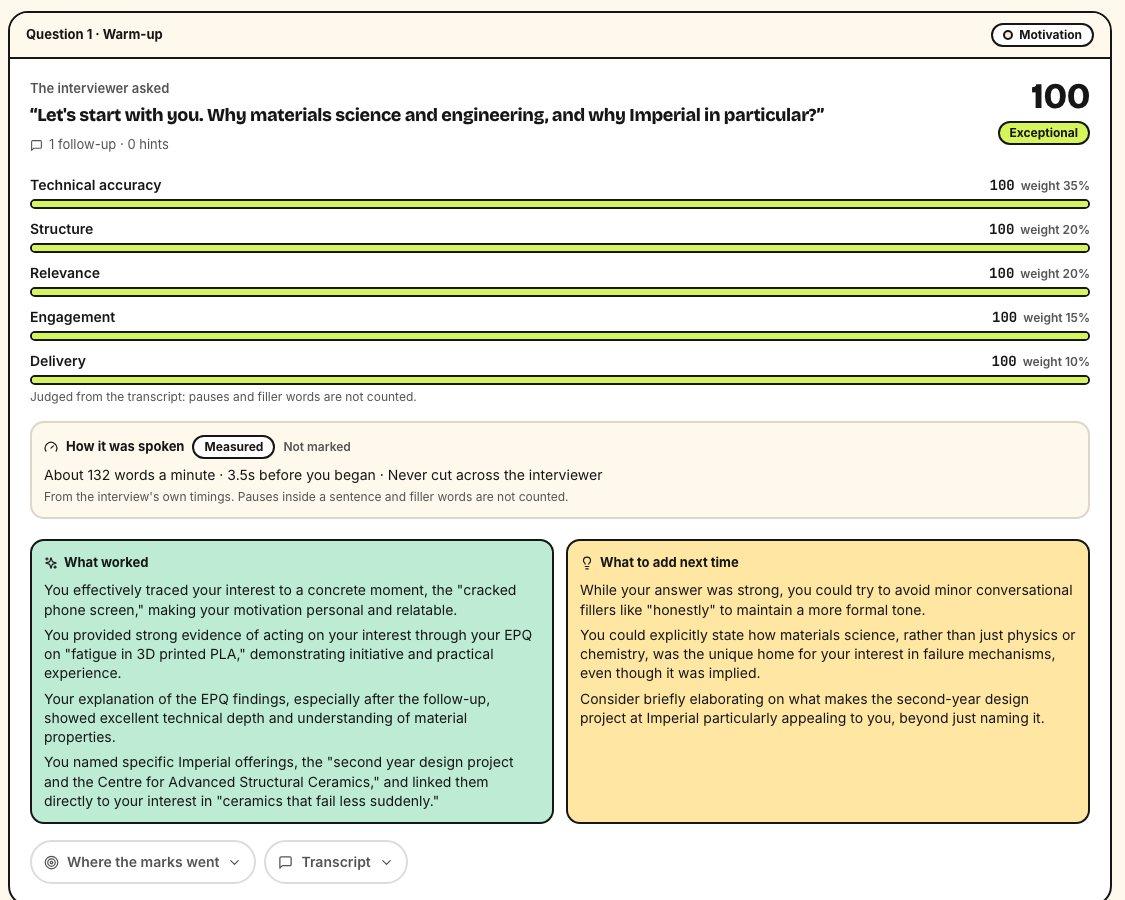
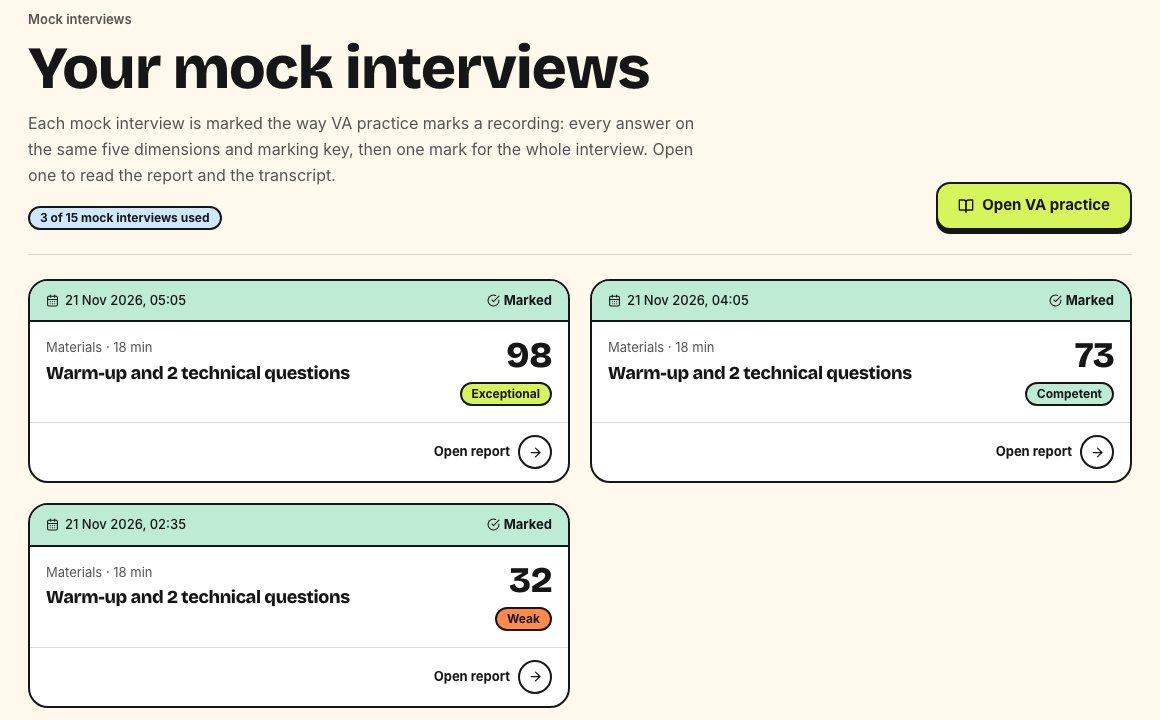
Frontier ACE · how it works
Rehearse the Imperial Design Engineering interview on Frontier ACE
- Imperial Design Engineering interview questions
- 40+
- Imperial Design Engineering interview questions
- of real interview questions covered
- 90%+
- of real interview questions covered
- mock interviews with follow-ups
- 1v1
- mock interviews with follow-ups
- scoring dimensions after each answer
- 5
- scoring dimensions after each answer
More Imperial interviews
Official sources
4 official sources (click to view)
Frequently asked questions
How long is the Imperial Design Engineering interview, and where?
Do I need a portfolio?
I am not predicted A*AA. Can I still apply?
Am I at a disadvantage if I sit the January ESAT?
Can the interview change my offer?
UAT-UK, Pearson, OCR, the University of Cambridge, Imperial College London and other names and logos belong to their respective owners.
Prepare for Imperial Design Engineering interview in four weeks
Work through the original subject questions, then rehearse the conversation with FrontierACE. Both are built by Frontier Academy.