Imperial Chemical Engineering

Imperial Chemical Engineering swaps Physics for Chemistry: prepare for four kinds of interview-day task

6 sections605 words4 min read4 official sources

Imperial Chemical Engineering at a glance

Admissions test
ESAT: Maths 1, Maths 2, Chemistry
Interview
Interview days: interview, group task, discussion, written test
Imperial’s interview season
Usually November to February, online or in person
Minimum
A*A*A with A* in Chemistry and Maths; IB 40
Applications per place
5 : 1 (2025)
UCAS code
H801

The one thing to do before the interview: pick one chemical process, such as ammonia synthesis, water treatment or carbon capture, and practise explaining the hardest step to control at plant scale.

Imperial Chemical Engineering selects through interview days that may include an interview, group task, discussion and written test, usually November to February. You need A* in both Chemistry and Maths, and the third ESAT module is Chemistry. We suggest practising all four. See the Imperial interviews overview.

In short

  1. 01Chemistry is the gate here: an A* at A level, and Chemistry as the third ESAT module. Prepare Chemistry as thoroughly as Maths.
  2. 02The department emails the address on your UCAS form with the format and whether it is online; plan your last few days around that email the day it arrives.
  3. 03An interview day may include a group task, discussion or written test; we suggest practising all three in advance.
  4. 04In year four you design a whole chemical plant, with environment and safety throughout: think about what changes when a reaction goes from a flask to a plant.
A lecturer writing equations on a chalkboard to a class
A lecturer writing equations on a chalkboard to a class · Illustration · AI-generated
Part 1

Course and entry requirements

Course

Department of Chemical Engineering, four-year MEng

UCAS code H801

A level

A*A*A with A* in Chemistry and Maths

Plus an A in Biology, Business Studies, Economics, Further Maths or Physics

IB

40 minimum, typically 41

7 in HL Maths and HL Chemistry, 6 in HL Biology, Business Management, Economics or Physics

Part 2

What an interview day may include

What it isHow we suggest preparing
Panel interview
Typically one or two academics from the department
Prepare follow-ups on every line of your statement; talk through chemistry and maths problems
Group taskSeveral applicants solve one problem together
State assumptions so others can build on them, then split the work
DiscussionExchanging views on one topic
Have one chemical engineering topic you can discuss, such as carbon capture or water treatment
Written testSolving problems on your own against the clock
Practise moles, equilibrium and estimation without a calculator

Your invitation email lists the tasks on the day; put your remaining preparation into those.

01October or January

ESAT, three modules

Maths 1, Maths 2 and Chemistry, 27 questions in 40 minutes each. 12 to 16 October 2026 or 4 to 8 January 2027; in mainland China, Hong Kong and Macau only 12 to 13 October and 6 January.
0213 January

UCAS deadline

13 January 2027 at 18.00 UK time.
03Usually November to February

Interview day

Imperial interviews applicants who show potential in their UCAS application and admissions test; the department contacts shortlisted applicants directly with the format and whether it is online.
04By the end of March

Decision

Sent through UCAS; Imperial aims to make all decisions by the end of March.
Part 3

What a chemical engineering question feels like: one practice problem, fully worked

From a 1-litre flask to a 1,000-litre reactor
An exothermic reaction runs safely in a 1-litre flask: it releases 50 W and the walls can remove at most 60 W. You scale the vessel up to 1,000 litres with the same shape and the same concentrations. What happens to heat release and heat removal, what goes wrong, and how would you fix it?
Frontier ACE mock practice4 steps + answer
  1. 1
    Find the scaling
    Volume × 1,000 means length × 10 for the same shape, so surface area × 10² = 100.
01

Chemistry without engineering

Wrong
Explaining the mechanism in detail with no mention of heat, energy or equipment.
Right
After the chemistry, ask what happens a thousand times bigger.
Spot it:
Your answer has no number about scale, cost or safety.
02

Confusing the two subjects

Wrong
Motivation is only “I like doing experiments”.
Right
Name a process problem you want to solve, such as making carbon capture cheaper.
Spot it:
The same answer would work unchanged at a chemistry interview.
Revise

What to revise for Imperial Chemical Engineering

Our recommended revision list, built from the admissions-test syllabus and the kinds of problems interviews use.

01

Chemistry

Chemistry needs an A* and has its own ESAT module, so it is a natural way into a question.

  • Moles and stoichiometry
  • Equilibrium and Le Chatelier
  • Rates and activation energy
  • Enthalpy changes and energy profiles
02

Mathematics

Maths also needs an A*, and process calculations rely on exponentials and rates of change.

  • Exponential growth and decay
  • Rates of change and simple differential equations
  • Order-of-magnitude estimates
03

Mass and energy balances

The first idea of chemical engineering: in equals out plus accumulation.

  • Conversion and yield
  • Mixing and dilution
  • Energy for heating and cooling
04

Scale-up, safety and environment

The course covers environmental impact and safety engineering throughout, ending with a full plant design.

  • Area-to-volume ratio
  • Thermal runaway
  • Carbon capture and emissions
Practise

4 practice questions for this course

Exclusive questions in the style of this interview. Talk each one through out loud first, then open the hints one at a time.

01Question 1New for this course
Roughly how much carbon dioxide does a 1 GW gas-fired power station emit per day? If you wanted to capture all of it, where would the hardest part be?
Frontier ACE mock practice4 steps
  1. What it tests
    It tests two things: whether you can chain energy, a chemical equation and units into one clean estimate, and whether you then switch to an engineer’s view of the hard parts. The exact number matters less than saying every assumption aloud.
  2. 1
    Step 1
    Start from energy and say your assumptions: “I will take the plant as about 50% efficient, so the fuel supplies about 2 GW of heat. Methane gives about 55 MJ/kg, so it burns 2 × 10⁹ / 5.5 × 10⁷ ≈ 36 kg of methane per second.”
A line takes 1000 kg of fresh juice an hour at 10% solids and concentrates it to 40% solids. How much water must be evaporated each hour, and roughly what heating power does that need?
Frontier ACE mock practice4 steps
  1. What it tests
    The textbook mass balance: find the conserved quantity, the solids, and the rest is one step. The second half adds an energy balance, turning mass into power through latent heat. The interviewer watches whether you find the conserved quantity before multiplying percentages.
  2. 1
    Step 1
    Draw the box: 1000 kg/h in, two streams out, concentrate and vapour. Name the conserved quantity: all the solids stay in the concentrate.
A 2 m³ reactor is fed at 10 L per minute with a first-order reaction, rate constant k = 0.01 per minute. If it is a well-stirred tank, what is the outlet conversion? What about a pipe reactor of the same volume? Why do they differ?
Frontier ACE mock practice4 steps
  1. What it tests
    Tests residence time and reactor type. A stirred tank sits at outlet concentration everywhere, while each slug in a pipe behaves like its own small batch. A-level exponential decay handles both, and the interviewer watches whether you derive the tank result from a balance yourself.
  2. 1
    Step 1
    Residence time: τ = V / Q = 2000 L / 10 L/min = 200 min, so kτ = 0.01 × 200 = 2. Say this dimensionless number first; both reactors depend only on it.
Your chemistry is strong. Why chemical engineering rather than chemistry? Use one specific product to show how the two care about different questions.
Frontier ACE mock practice4 steps
  1. What it tests
    The commonest motivation question in chemical engineering. Checkable facts from the course page: A* in both Chemistry and Mathematics; environmental impact and safety engineering throughout; a fourth year investigating every aspect of designing a chemical plant; a Carbon Capture Pilot Plant. The interviewer wants the two subjects separated by scale, safety, energy and cost, not by “chemical engineering is more practical”.
  2. 1
    Step 1
    Pick one product, such as aspirin or the ammonia in fertiliser. Say what a chemist asks: route, mechanism, yield, purity, made in a flask.
Checklist

The two weeks before your interview

0 of 9 done

Progress is saved in this browser only.

Question set

Chemical Engineering interview questions

Original questions with full walkthroughs

6questions

Each one shows what the interviewer is testing, the steps to say out loud and the likely follow-up.

Open the question set
  1. 01Water removed when concentrating fruit juice
  2. 02Why ammonia plants recycle unreacted gas
  3. 03Why distillation stops short of pure ethanol
  4. 04Same reactor time, stirred tank or pipe

Frontier ACE · how it works

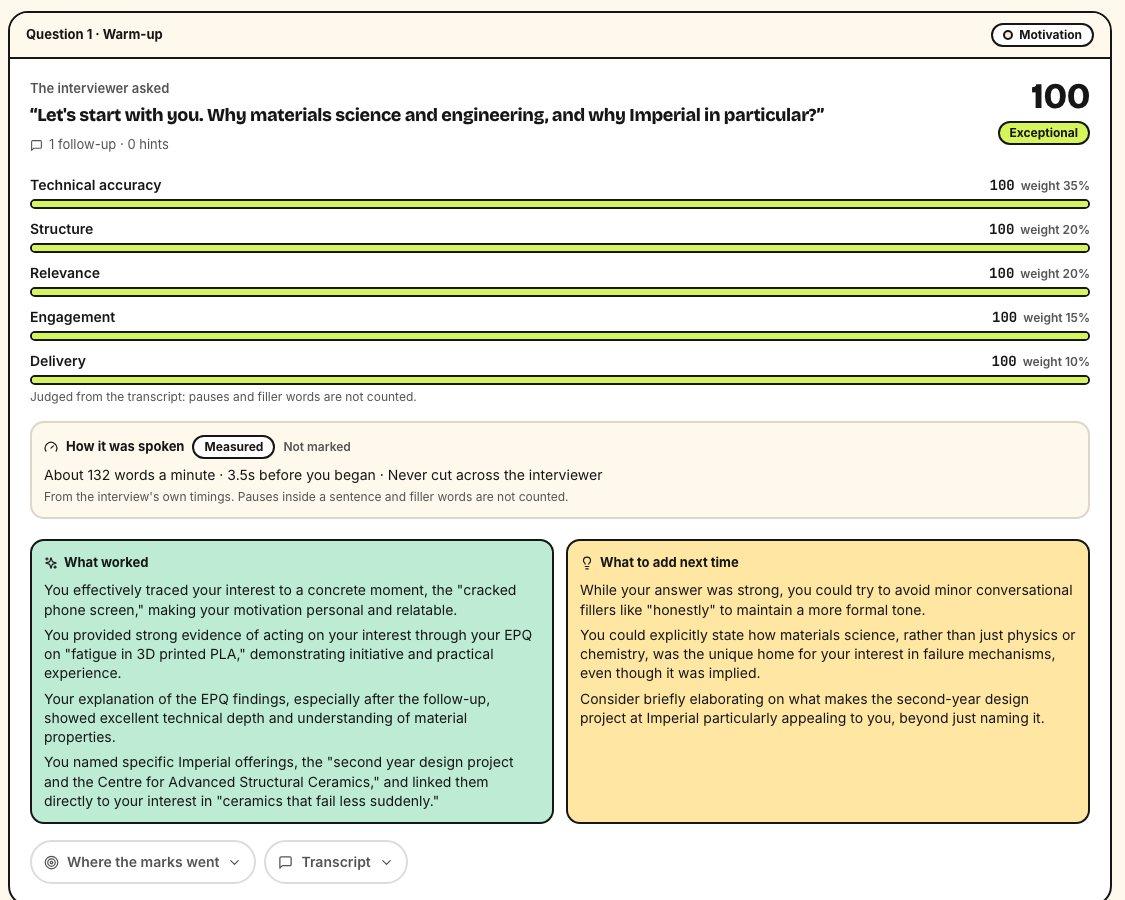
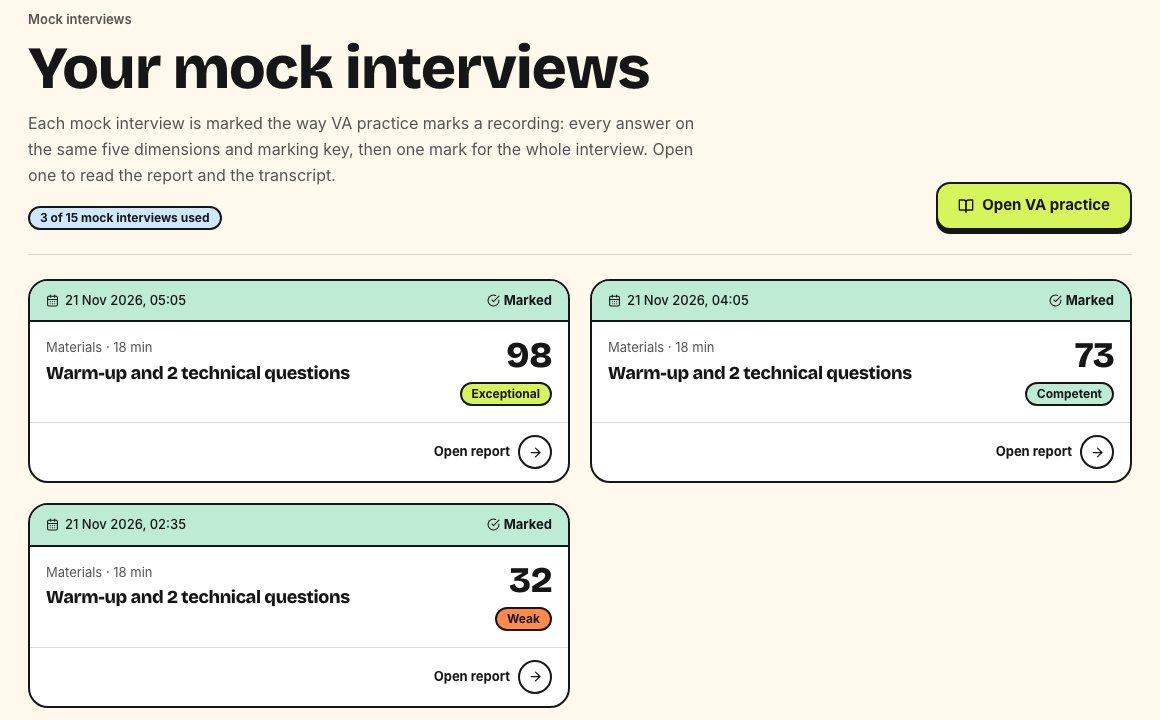
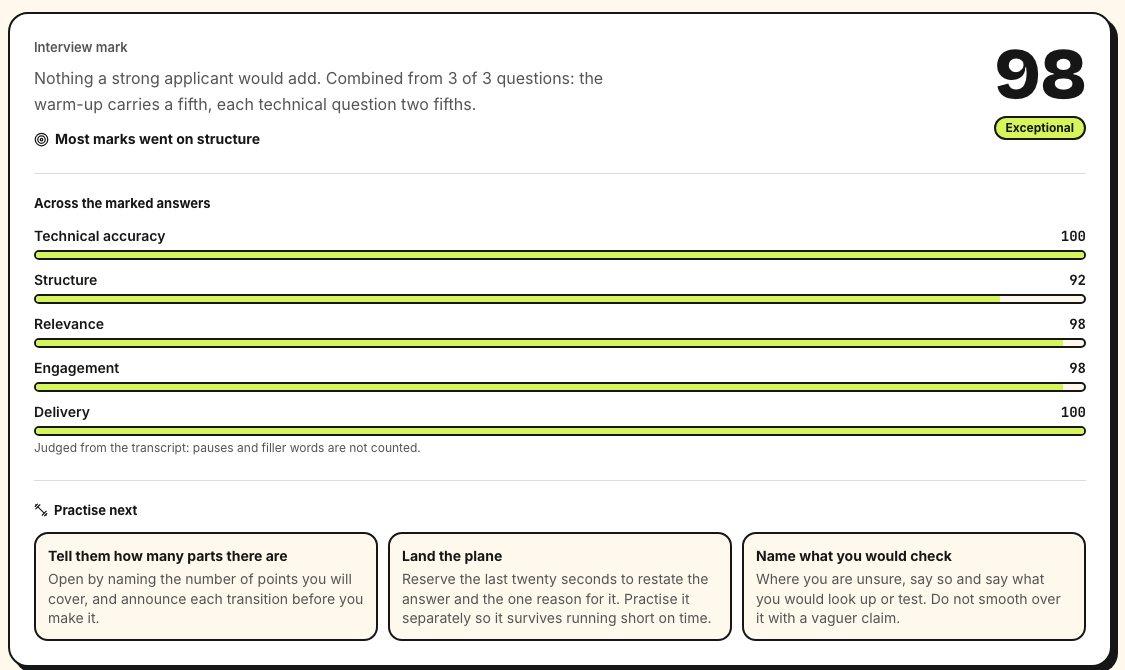
Rehearse the Imperial Chemical Engineering interview on Frontier ACE

Imperial Chemical Engineering interview questions
40+
Imperial Chemical Engineering interview questions
of real interview questions covered
90%+
of real interview questions covered
mock interviews with follow-ups
1v1
mock interviews with follow-ups
scoring dimensions after each answer
5
scoring dimensions after each answer
frontierace.ai
The Frontier ACE interviewer
Same university

More Imperial interviews

Sources

Official sources

4 official sources (click to view)
FAQ

Frequently asked questions

Is the Imperial Chemical Engineering interview online or in person?
Either is possible, depending on your circumstances and the course, and the department will say which in your invitation. We suggest preparing for both: test your camera and paper set-up for online, and plan your route for in person.
Which ESAT modules do I need?
Maths 1, Maths 2 and Chemistry, each 27 multiple-choice questions in 40 minutes. There are October and January windows for 2027 entry.
If I take four A levels, which fourth subject is best?
The department prefers the fourth to be Physics, Biology, Further Maths, Business Studies or Economics at grade A. The typical four-subject offer is A*A*AA.
Do I apply separately for the Year Abroad version?
No. Everyone applies to the standard MEng (H801) first; students with marks of 60% and above can normally transfer, usually until the end of the autumn term of year two.

UAT-UK, Pearson, OCR, the University of Cambridge, Imperial College London and other names and logos belong to their respective owners.

Prepare for Imperial Chemical Engineering interview in four weeks

Work through the original subject questions, then rehearse the conversation with FrontierACE. Both are built by Frontier Academy.